Sector
DDoS Protection for Online Gaming Platforms
Last updated: August 2026 · A surviving session can still be a lost one · Reading time ~13 min

In gaming the defence has to protect something stricter than reachability: a session that survives with added latency has already failed. Two further properties make the sector unusual — legitimate traffic is UDP-heavy and connectionless, which defeats defaults written for TCP, and a large share of attacks are launched by players against other players, at volumes small enough to miss.
Most DDoS material assumes that a request which completes is a request that succeeded. Gaming breaks that assumption, and nearly everything unusual about the sector follows from it.
A player whose packets arrive 120 milliseconds late is not experiencing a degraded service. They are losing, and they will leave.

At a glance
| Appliance | Property | Ordinary estate | Gaming platform |
|---|---|---|---|
| Success condition | The request completed | The request completed within the frame budget | |
| Dominant protocol | TCP, with handshakes to reason about | UDP, connectionless, no handshake to validate | |
| Typical attacker | External, financially or politically motivated | Frequently a player, targeting another player | |
| Attack size that matters | Large enough to saturate | Small enough to add latency, and easily missed | |
| Exposed asset | Public services | Also the players' own addresses, which you do not control |
Every row shifts the problem toward smaller, faster, more distributed events — the opposite of the volumetric case most defences are marketed against.
Latency is the availability metric
The practical consequence is that the useful capacity figure is not the point at which the defence drops traffic. It is the point at which the defence adds delay.
Those are different numbers, and only the first appears on datasheets. A device operating well within its rated packet rate can still add jitter under load, and jitter is worse than latency for real-time traffic: a consistent 40 milliseconds is playable, and 20 milliseconds varying to 90 is not.
Two design consequences:
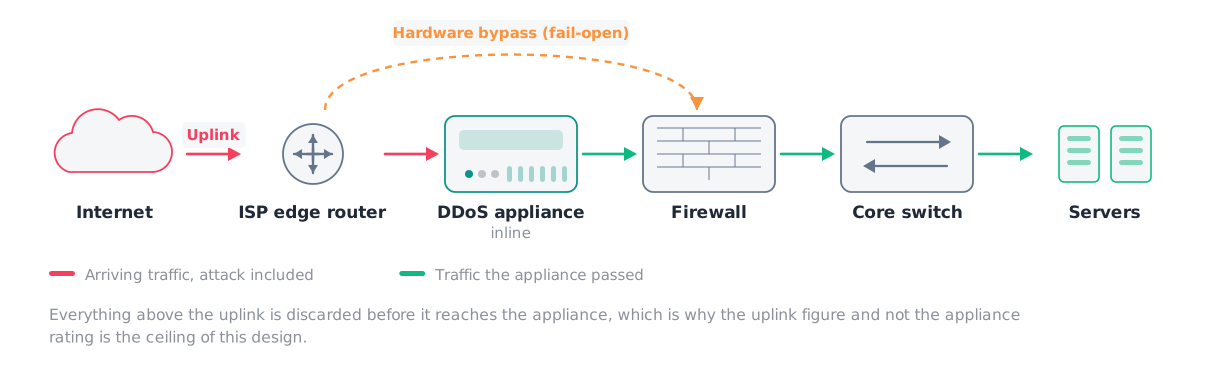
Diversion is expensive here. An out-of-path, on-demand architecture that engages in ninety seconds has already lost the match. Where session latency is the product, inline and always-on is usually the only posture that fits, and the failure-domain cost is paid deliberately.
Measure jitter, not just latency. Test acceptance criteria should include a jitter bound under mitigation, which almost no standard test plan contains.
UDP breaks the defaults
Real-time game traffic is connectionless because retransmission is the wrong behaviour when the payload is a position update that will be stale by the time it arrives.
That removes the cheapest defensive tool in the field. SYN proxy and cookies work because a handshake can be completed without allocating memory, proving the client exists. UDP has no handshake to complete, so source validation has to happen inside the game protocol — a token or challenge in the application’s own first exchange — or through rate and behaviour analysis that knows what your traffic looks like.
It also means the normal profile is alarming to any defence tuned for web estates: high packet rates, small packets, no connection state, sustained continuously. A behavioural baseline learned on the wrong assumptions will treat ordinary play as an attack, which is the self-inflicted outage in its most predictable form.
The attacker is frequently a customer
This is the sector-specific feature that changes the operational model.
A large share of gaming DDoS is players attacking players: a losing opponent buying a few minutes of traffic against another player’s home connection, or against a small server. The volumes are tiny by the standards of this field — well below anything that would trouble your circuit — and the effect on the target is total.
Three consequences:
Peer-to-peer connectivity is the root cause. If players can see each other’s addresses, they can attack each other, and no defence on your infrastructure helps. Relay or proxy architectures remove the exposure and cost latency and money. That is a product decision, and it is the most important one in this section.
Your own thresholds will miss it. An attack that never approaches your circuit capacity is invisible to volume alerting. Detection has to be per-session and per-player rather than aggregate.
Abuse handling becomes part of the defence. Where the attacker holds an account, account action is a control that no appliance provides, and correlating an attack window with a match and a player requires the telemetry to be joinable to game data. That is an engineering requirement, decided long before an incident.
The estate splits into three
Gaming platforms rarely need one uniform posture, and treating them as uniform is the common sizing mistake.
Login and account services. Ordinary TCP web traffic, ordinary web defences, and the highest value to an attacker because taking down login stops everyone. Anycast, rate limiting and challenge mechanisms all apply here without harming the product.
Matchmaking and lobby. Request-response, moderately latency-sensitive, and a chokepoint. This is frequently the most attractive target and the least protected, because it looks like a minor internal service on an architecture diagram.
Game servers. UDP, latency-critical, stateful in the application sense. Everything above about jitter, UDP validation and inline posture applies here and nowhere else.
Sizing each separately is the difference between a proportionate design and one that either over-buys for the web tier or under-protects matchmaking. The arithmetic is in capacity sizing; the split is the part that has to be decided first.
What to specify
- Added latency and jitter under mitigation at half rated capacity, per traffic class.
- UDP source validation mechanism, and whether it requires a change to the game protocol.
- Per-session and per-player detection, not only aggregate volume thresholds.
- Telemetry joinable to game data, so an attack can be tied to a match and an account.
- Inline, always-on posture for game servers, with bypass behaviour specified.
- Player address exposure: whether the architecture reveals it, and what a relay would cost.
The last item is not a security product decision and is usually the one that removes the most attacks. It is worth putting in front of the people who own the game architecture rather than the people who own the network.
Frequently asked questions
- Why does UDP make this harder?
- Because most of the cheap validation tricks depend on a handshake. There is no UDP equivalent of a SYN cookie proving the client exists, so source validation has to happen in the game protocol itself or through rate and behaviour analysis. It also means the normal traffic profile looks, to a defence written for web estates, like an attack.
- Should we block UDP outright?
- No, and the temptation is worth naming because it is common. Real-time gameplay uses UDP by design, because retransmission is worse than loss when the data is a position update. Blocking or aggressively rate-limiting UDP breaks the product. What works is validating within the game protocol and rate-limiting per source with limits derived from measured play, not from defaults.
- How do we protect players from being attacked directly?
- By keeping their addresses out of reach. Peer-to-peer connectivity exposes every player's address to every other player, which is the root of the sector's most common attack. Relay or proxy architectures remove that exposure at a cost in latency and infrastructure, and the trade is a product decision rather than a security one.
- Does anycast help?
- For login, matchmaking and other request-response services, considerably: it distributes load and shortens paths. For an active game session it is less useful, because a session generally needs a stable server and moving it mid-match is worse than the attack. Split the estate and apply it where it fits.
Sources
- RFC 4732 — Internet Denial-of-Service Considerations
IETF · 2006-11 · standard · accessed 2026-08-17
- RFC 8085 — UDP Usage Guidelines
IETF · standard · accessed 2026-08-17
Why connectionless traffic behaves as it does under loss and congestion, which is the behaviour a defence must not misread.
- RFC 2827 / BCP 38 — Network Ingress Filtering
IETF · standard · accessed 2026-08-17
Published: August 2026 · Last reviewed: August 2026
Reviewed means the sources above were re-read on that date; the text is only reissued when something material changed.
This guide is updated as vendors release new models and pricing. How we compare vendors