Foundation
What DDoS Mitigation Is, and What It Cannot Do
Last updated: August 2026 · The reference definition, stage by stage · Reading time ~32 min

DDoS mitigation is the practice of keeping a service reachable while it is deliberately flooded, by detecting abnormal traffic, classifying what kind of attack it is, and enforcing a response — dropping, rate-limiting, challenging or diverting — close enough to the source that legitimate requests still get through. It is a set of controls at several layers rather than one product.
A distributed denial-of-service attack does not break anything. It asks for service — a great deal of it, from a great many places, all at once — and the failure that follows is the service doing exactly what it was built to do until it runs out of something. Bandwidth, packets per second, connection-table entries, worker threads, database connections, or the budget of a person who has to decide what to turn off.
That is why the defence is called mitigation rather than prevention. You cannot stop the requests from being sent. You can decide, quickly and at scale, which of them to answer.

The definition, and the three words that carry it
DDoS mitigation is the practice of keeping a service reachable while it is deliberately flooded, by detecting abnormal traffic, classifying what kind of attack it is, and enforcing a response close enough to the source that legitimate requests still get through.
Each of those three words is load-bearing, and each fails in its own way.
Detection is a question about time. Every second between the first attack packet and the first mitigated packet is a second of degraded service, so a defence that identifies an attack perfectly but slowly has produced an outage with excellent forensics. This is why time-to-mitigate is a first-class metric rather than a footnote.
Classification is a question about accuracy. Deciding that traffic is abnormal is not the same as deciding what to do about it, and the gap between those two decisions is where false positives live. A flood of TCP SYNs from spoofed sources and a genuine traffic spike from a marketing campaign both look like a step change in connection rate; treating the second as the first is a self-inflicted outage.
Enforcement is a question about proportion. The blunt answers — drop everything to this destination, blackhole the prefix — always work and always cost you the thing you were defending. The precise answers cost state, cost processing, and can be evaded. Most real mitigation is a ladder between those two, climbed as the evidence gets stronger.
What mitigation actually does, stage by stage
The lifecycle is worth walking once, because most disagreements about products turn out to be disagreements about which stage is being discussed.
Attack begins. Something starts sending you traffic you did not ask to serve. It may be a botnet, a set of reflectors amplifying small requests into large responses, or a modest number of hosts sending requests that are individually cheap to make and expensive to answer.
Detection. A defence notices, using whatever it can see: flow records exported by routers RFC 7011, packet counters, connection-establishment rates, or application signals like request rate per URL. What it can see determines what it can notice, which is why a defence that only reads flow records is structurally late to an application-layer attack.
Classification. The defence decides what kind of attack this is and, critically, against which destination. Carpet-bombing campaigns exist precisely because a per-destination threshold never trips when the volume is spread across a whole prefix. Classification that aggregates only at host level cannot see them.
Enforcement. Something is done: packets dropped, rates limited, handshakes proxied, clients challenged, or the traffic diverted to somewhere with more capacity. Which action is available depends entirely on where the enforcement point sits.
Clean traffic. Legitimate requests reach the service. This stage gets far less attention than it deserves, and it is where hybrid designs most often go wrong: getting scrubbed traffic back to the origin involves tunnels, asymmetric routing and MTU questions that have nothing to do with how good the scrubbing was.
Recovery. Mitigation is withdrawn, the incident is reviewed, and the evidence is retained. Skipping this stage is free on the day and expensive later, because the reporting duty that arrives after a significant incident is a data duty — you cannot capture the telemetry retroactively.
Three attack families, three different defences
The taxonomy that matters operationally is not the OSI layer but the resource being consumed.
Volumetric attacks aim at bandwidth. Reflection and amplification are the usual mechanism: the attacker sends small requests with a forged source address to servers that answer with much larger responses, and the responses arrive at the victim. The defining property is that the traffic is large before it is anything else, so the defence must sit somewhere with more capacity than the attack — which almost never means your own rack.
Protocol and state-exhaustion attacks aim at the tables. A SYN flood consumes half-open connection slots; an ACK flood makes a stateful device look up sessions that do not exist; fragmentation attacks consume reassembly buffers. These do not need to be large. A few hundred megabits of well-chosen packets can exhaust a firewall that advertises tens of gigabits of throughput, because the constraint is state rather than bandwidth. This is the family that most often surprises people who sized their defence in Gbps.
Application-layer attacks aim at work. Requests are individually valid, complete a handshake, and ask the service to do something expensive: a search, a report, a login attempt, a cache-missing query. They are small, they are hard to distinguish from real users without knowing your application, and they are the reason “how many gigabits can it handle” is an incomplete question.
A real campaign usually mixes at least two of these, often deliberately — the volumetric component saturates attention while the application-layer component does the damage.
Each family has its own page: SYN flood for the state-exhaustion case, reflection and amplification for the volumetric one, and HTTP flood for the application layer. Terms used without definition anywhere on this site are in the glossary.
Layer 3, Layer 4 and Layer 7 are three different problems
At Layer 3 and Layer 4 a defence can judge traffic without understanding it. Is this source plausible? Does this packet belong to a session that exists? Is this rate consistent with the last four weeks? Judgements of that kind can be made statelessly, at very high packet rates, and by a device that knows nothing about the application behind it.
At Layer 7 that is no longer true. Deciding whether a request is abusive requires knowing what this service normally receives, which endpoints are expensive, and what a real user session looks like. It requires terminating the connection, which costs state, and often decrypting it, which costs processing and raises questions about where the private keys and the plaintext are allowed to be.
The practical consequence is that competence at one layer says almost nothing about competence at the other, and that the two are frequently delivered by different components. A design that assumes a single box is equally strong at both should verify it rather than infer it.
Where the inspection sits: inline and out-of-path
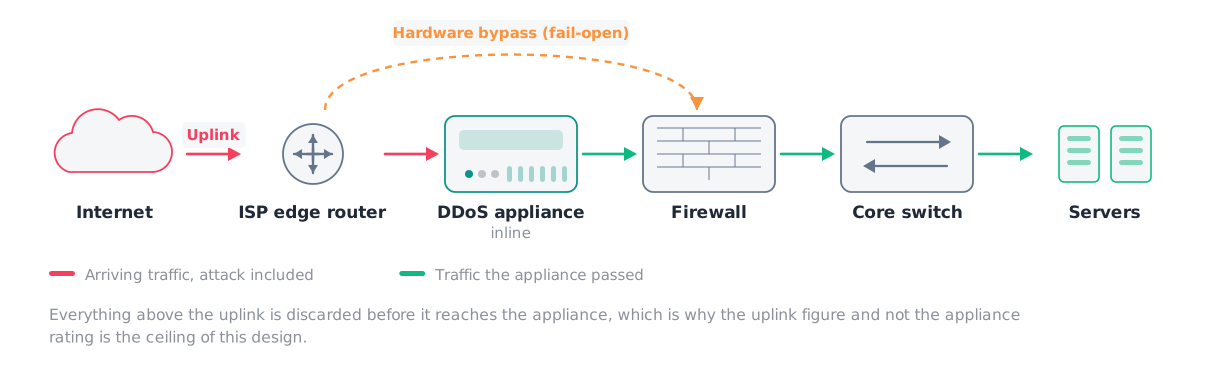
Inline means the device is in the traffic path and every packet passes through it. It can act on the first bad packet with no diversion delay, and it sees both directions of a session, which is what makes protocol-state and application-layer decisions possible. The cost is that it is now part of your availability: its failure modes, its bypass behaviour and its maintenance windows are your failure modes, bypass behaviour and maintenance windows.
Out-of-path means the device receives copies of traffic or flow records, decides, and then causes traffic to be diverted to it — by a BGP announcement, a FlowSpec rule RFC 8955, or a signalling protocol such as DOTS RFC 8811. Nothing is in the path in steady state, which removes a class of risk entirely. What it costs is time at the beginning of every incident, because diversion is a routing change and routing changes converge on their own schedule.
Neither is a better answer in general. The choice follows from how short your attacks are and how much steady-state risk you are willing to hold.
Where the capacity sits: on-premises, cloud and hybrid
An on-premises tier sits at your own edge, ahead of the servers. It sees your traffic in full, decides locally, holds its own telemetry, and answers protocol-state and application-layer attacks immediately because there is nothing to divert. It cannot answer volume larger than the circuit that feeds it, and no configuration changes that.
A cloud scrubbing tier sits in a provider’s network with far more capacity than yours. It answers volume, which is the part you structurally cannot answer, and it answers it at a scale that would be absurd to build. What it does not naturally hold is the history of your particular application, and what it does not naturally give you is telemetry on your own schedule.
A hybrid design uses both, and the interesting question is not whether to have both but who owns which decision, and what happens when one of the two is unavailable. A hybrid bought as a single bundle from a single supplier is operationally simpler and concentrates exactly the dependency the design was meant to spread; a hybrid assembled from two suppliers spreads the dependency and costs an integration you now own. Both are defensible. Neither is free.
The full comparison of cloud, on-premises and hybrid works through the trade in detail, and the multi-vendor question takes the concentration argument further than there is room for here.
Detection telemetry: what a defence is actually reading
Every detection decision is made from one of four kinds of evidence, and the kind determines the class of attack that can be seen.
Flow records — IPFIX, NetFlow, sFlow RFC 7011 — summarise conversations after the fact: source, destination, ports, byte and packet counts. They are cheap, they scale to carrier networks, and they are sampled, which means they are excellent at volume and structurally blind to anything small.
Packet-level counters capture rates and sizes as traffic passes. They are what makes packet-rate attacks visible at all, and they are the reason packet size matters so much in testing: a device that handles 100 Gbps of 1518-byte frames may collapse under a fraction of that in 64-byte packets, because the constraint is packets per second rather than bits.
Connection state — half-open counts, session-table occupancy, handshake completion rates — is what makes state-exhaustion attacks visible before the table is full rather than after.
Application signals — requests per second per endpoint, response codes, latency distributions, cache hit rates — are the only evidence that distinguishes an expensive legitimate request from an expensive malicious one. They exist only where something terminates the connection.
A defence sees the attacks its telemetry can describe. This is worth stating plainly because it explains, without any reference to product quality, why a flow-based detector is late to a slow application-layer attack: not because it is badly built, but because the evidence it reads does not contain the event.
False positives, goodput, and the number nobody quotes
The metric that matters during an attack is goodput: the legitimate traffic that still reaches the service while mitigation is active. It is not the same as throughput, and it is the number most likely to be missing from a datasheet.
The reason it is missing is that it is a property of the deployment rather than the device. Goodput depends on how well the baseline describes your traffic, how much of your legitimate traffic resembles the attack, and how aggressively you have tuned. A defence that drops everything achieves perfect mitigation and zero goodput, which is a distinction that only matters to the business rather than to the graph.
This makes false-positive testing an obligation rather than an optional extra in any acceptance plan. Replay real traffic alongside the attack. Measure what fraction of the real traffic survives. Repeat it at your genuine business peak, because a threshold that is comfortable at 3am is a different threshold at the busiest hour of the quarter.
Capacity is not efficacy
Two products can both claim a large number and mean entirely different things by it, so it is worth separating the claims that get conflated.
Capacity is how much traffic a device can process before it becomes the bottleneck, usually stated as bits per second and, if the vendor is being helpful, also as packets per second at a stated packet size. It is a ceiling, and it is normally the ceiling of the largest model in a family rather than the one you will be quoted.
Efficacy is how correctly it decides, which is a different axis entirely and much harder to state. It shows up as detection time, false-positive rate under realistic traffic, coverage across attack classes, and behaviour on vectors it has not seen before.
A device with enormous capacity and weak classification will forward an attack very quickly. A device with excellent classification and insufficient capacity will make correct decisions until it is overrun. Both failures are common, and only one of them is visible on a specification sheet — which is the entire argument for a proof of concept that measures the other.
Clean traffic has to get back
In a diversion design, traffic is pulled away from its normal path, cleaned, and then has to be delivered to the origin. That return path is a design decision with consequences that regularly surprise people who treated it as plumbing.
It is normally a tunnel — GRE, or a dedicated circuit, or a cloud interconnect — and a tunnel reduces the usable MTU, which means path MTU discovery and TCP MSS clamping become part of your availability. It also makes routing asymmetric: traffic arrives through the scrubbing provider and leaves directly, which breaks anything in the path that expects to see both directions of a session. Stateful devices sitting between the tunnel endpoint and the servers are the usual casualty.
None of this is an argument against diversion. It is an argument for testing the return path under load before an incident rather than during one, and for asking the question in the procurement stage where it still changes the design.
Protection is not one control
The single most useful correction to make early is that DDoS protection is not a product category you buy once. It is a set of controls at different places in the path, each answering what the others cannot.
Ingress filtering at network borders RFC 2827 RFC 3704 limits the spoofed sources that make reflection attacks possible. It protects other people from your network rather than your network from other people, which is why it is a shared obligation rather than a competitive feature, and why adoption remains uneven.
Blunt upstream instruments — remotely triggered black hole filtering RFC 5635, FlowSpec rules — stop saturation from reaching you at the cost of dropping some or all traffic to a destination. They are the tools of last resort, and having them rehearsed matters more than having them documented.
Dedicated mitigation, wherever it sits, does the work of separating good from bad.
Host and platform tuning raises the floor underneath all of it: kernel and network-stack limits, web-server timeouts, application-server connector settings. This is the layer covered in the hardening section, and its honest role is to decide whether a moderate flood is an incident or a graph. It never absorbs saturation.
Operational readiness — who decides, on what evidence, at what hour, with what escalation path — is the control most likely to be missing and least likely to be budgeted. NIST’s incident-handling guidance NIST SP 800 61R3 is the usual external reference for structuring it, and the CSF NIST CSF 2 is a workable frame for organising the evidence.
What DDoS mitigation does not solve
Being precise about the limits is more useful than being reassuring about the capabilities.
It does not undo saturation. When the volume arriving at your transit circuit exceeds what the circuit can carry, packets are already being discarded upstream of everything you control. This is the one constraint that no amount of local capability changes, and it is why upstream capacity is part of the design rather than an alternative to it.
It does not fix an application that falls over under load. If a single request can consume a database connection for eight seconds, an attacker needs remarkably little traffic. Rate limiting buys time; it does not repair the underlying economics.
It does not stop targeted exploitation. Availability defence and vulnerability defence are different disciplines that happen to share a perimeter. A DDoS appliance will not notice an authentication bypass.
It does not produce compliance. Regulatory regimes place duties on the entity — manage the risk, notify within a clock, assess your suppliers — and those duties cannot be transferred to a supplier or discharged by a purchase. What a well-chosen architecture does is make the answers short and evidenced. The regulation section works through what specific regimes actually require.
It does not remove the need to decide. Every mitigation posture is a standing decision about what to sacrifice under pressure. Making that decision in advance, in writing, is the part no product performs for you.
Choosing a shape
| Appliance | Where inspection happens | What it answers well | What it cannot answer | Who it suits |
|---|---|---|---|---|
| Upstream or carrier filtering | In your transit provider's network | Volume that would saturate your circuit | Application-layer requests that look legitimate | Anyone whose circuit is smaller than a plausible attack |
| Cloud scrubbing | In a provider's scrubbing centres | Large volumetric and protocol floods | Anything requiring your own traffic history to judge | Services that can tolerate a diversion delay or run always-on |
| On-premises appliance | At your own edge, before the servers | Protocol-state and application-layer attacks, immediately | Volume larger than the circuit feeding it | Estates that hold their own evidence and need L7 depth |
| Host and platform tuning | On the servers themselves | Raising the floor under moderate load | Anything that arrives as saturation | Everyone, as a baseline rather than a defence |
These are layers, not alternatives. Almost every workable design combines at least two, and the question is which one owns each decision rather than which one wins.
The order to work through it in is unglamorous and reliable: establish what has to stay available and what latency it tolerates; measure your normal peak in both bits and packets; find the smallest circuit in the path, because that is your ceiling; decide what evidence you must be able to produce and how quickly; and only then look at products. A shortlist built that way is short. A shortlist built from datasheets is long and does not converge.
Related standards and primary sources
The standards below are the primary references behind this page. None of them mandates a product, and a vendor claim that a standard requires a particular architecture should be checked against the text.
Frequently asked questions
- What is DDoS mitigation in one sentence?
- It is the practice of keeping a service reachable while it is deliberately flooded, by detecting abnormal traffic, working out what kind of attack it is, and enforcing a response close enough to the source that legitimate requests still get through. The word "mitigation" is doing real work in that sentence: the traffic does not stop arriving, it stops mattering.
- Is DDoS mitigation the same as a firewall or a WAF?
- No, and the difference is structural rather than a matter of features. A firewall holds state for every session it permits, which is exactly the resource a state-exhaustion attack sets out to consume, so a firewall under that class of attack is a target rather than a defence. A web application firewall inspects requests it has already accepted and terminated, which makes it useful against application-layer abuse and useless against a flood that never completes a handshake. Dedicated mitigation is built to decide about traffic without first committing resources to it.
- Can DDoS mitigation stop every attack?
- No. Once the volume arriving at your transit circuit exceeds what the circuit can carry, the damage is done upstream of anything you own, and no device in your rack can undo it. That single constraint is what makes upstream capacity a component of the design rather than an upsell. Everything below saturation is genuinely addressable.
- What is the difference between Layer 3, Layer 4 and Layer 7 attacks?
- They exhaust different things. Layer 3 and Layer 4 attacks — floods of packets, spoofed handshakes, reflected responses — consume bandwidth, packet-processing budget or connection-table entries, and can usually be judged without understanding the application. Layer 7 attacks send requests that are individually valid and expensive to serve, so judging them requires knowing what normal looks like for your specific service. A defence strong at one is not automatically competent at the other.
- What is goodput and why does it matter more than throughput?
- Goodput is the legitimate traffic that still reaches the service during mitigation. Throughput tells you how much a device can process; goodput tells you how much of your business survived the decision it made. A defence that blocks the attack completely and takes ten per cent of real customers with it has produced an outage with better graphs, which is why false-positive rate belongs in an acceptance test alongside capacity.
- What is the difference between inline and out-of-path mitigation?
- An inline device sits in the traffic path and can act on the first bad packet, at the cost of being in the path of every good one too, which makes its failure modes and bypass behaviour part of your availability design. An out-of-path device receives copies or flow records, decides, and then has traffic diverted to it — which adds no steady-state risk but costs time at the start of an incident, because diversion is a routing change rather than an instruction.
- Do I need on-premises equipment if my provider already offers protection?
- It depends on what you have to be able to prove and how fast you have to react. An upstream service answers volume, which is the part you cannot answer yourself. It typically does not hold the per-request history your application-layer decisions depend on, and the telemetry from it arrives on the provider's export schedule rather than yours. If a regulator or a customer will ask you what happened, where that evidence lives is an architectural question rather than a procurement detail.
- How is DDoS mitigation tested honestly?
- Against your own infrastructure, with written authorisation, using a plan that includes false-positive tests rather than only volume tests. Replay your own application traffic alongside the attack and measure what fraction of it survives, at packet sizes that stress packet rate rather than only bit rate. A test that measures how much attack traffic was blocked, without measuring how much legitimate traffic was blocked with it, has measured half the product.
- Which standards actually govern this?
- None of them mandate a product. RFC 4732 frames the problem class; BCP 38 and BCP 84 define the ingress filtering that limits spoofed sources; RFC 5635 covers remotely triggered black hole filtering; RFC 8955 defines BGP FlowSpec; the DOTS documents define standards-based signalling between an operator and an upstream mitigator; and IPFIX is the flow-export standard your telemetry probably speaks. Regulatory regimes impose availability and reporting duties, and leave the architecture to you.
Sources
- RFC 4732 — Internet Denial-of-Service Considerations
IETF · 2006-11 · standard · accessed 2026-08-15
The clearest statement of the problem class, and still the reference for why some of it is structural rather than fixable.
- RFC 2827 (BCP 38) — Network Ingress Filtering
IETF · 2000-05 · standard · accessed 2026-08-15
- RFC 3704 (BCP 84) — Ingress Filtering for Multihomed Networks
IETF · 2004-03 · standard · accessed 2026-08-15
- RFC 5635 — Remote Triggered Black Hole Filtering with uRPF
IETF · 2009-08 · standard · accessed 2026-08-15
- RFC 8955 — Dissemination of Flow Specification Rules
IETF · 2020-12 · standard · accessed 2026-08-15
- RFC 9132 — DOTS Signal Channel Specification
IETF · 2021-09 · standard · accessed 2026-08-15
- RFC 8811 — DDoS Open Threat Signaling (DOTS) Architecture
IETF · 2020-08 · standard · accessed 2026-08-15
- RFC 7011 (IPFIX) — Specification of the IP Flow Information Export Protocol
IETF · 2013-09 · standard · accessed 2026-08-15
- The NIST Cybersecurity Framework (CSF) 2.0
NIST · standard · accessed 2026-08-15
- SP 800-61 Rev. 3 — Incident Response Recommendations and Considerations for Cybersecurity Risk Management
NIST · standard · accessed 2026-08-15
Published: August 2026 · Last reviewed: August 2026
Reviewed means the sources above were re-read on that date; the text is only reissued when something material changed.
This guide is updated as vendors release new models and pricing. How we compare vendors