Attack class
HTTP Flood and Application-Layer Attacks
Last updated: August 2026 · Valid requests, ruinous in aggregate · Reading time ~10 min

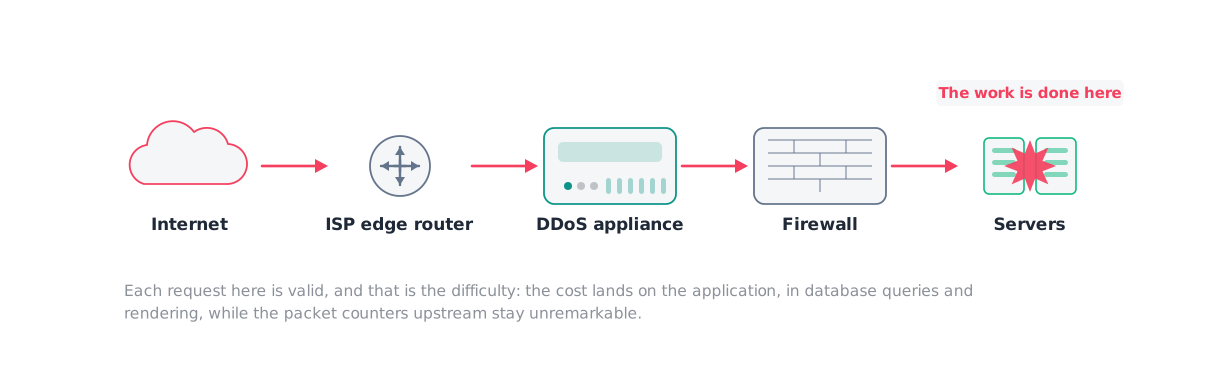
An HTTP flood sends requests that complete the handshake and are individually valid. The resource it exhausts is work — worker threads, database connections, cache misses — rather than bandwidth, so an attack that would not register on a traffic graph can take the service down. Judging it requires knowing what your application costs, which is history no generic filter holds.

What it exhausts
Work. Application worker threads, database connections, cache capacity, and the CPU spent on whatever the request asked for RFC 4732.
The consequence is that this class breaks the usual mental model. A volumetric attack is visible on any bandwidth graph; an application-layer flood can be invisible on all of them while the service is entirely unavailable.
Where the leverage comes from
The attacker’s advantage is asymmetry of cost. A request is cheap to send and can be expensive to answer: a search across a large corpus, a report that aggregates, a login that hashes a password deliberately slowly, a query that misses every cache.
Finding those endpoints is not hard — they are usually the ones a normal user waits for. An attack that targets them extracts far more damage per packet than any flood.
Variants worth separating
Cache-bypass requests append varying query strings or target personalised paths, so a CDN forwards every one to the origin. The CDN is working correctly and providing no protection.
Low-and-slow holds connections open while sending very slowly, consuming concurrency rather than throughput. Covered separately in the slow-HTTP class.
HTTP/2 Rapid Reset exploits stream multiplexing RFC 9113: many streams opened and cancelled on one connection, each causing request-handling work that is then thrown away. This is the vector behind the 2023 record requests-per-second attacks, and the corresponding CVE is in the CVE dataset.
Login and authentication floods aim specifically at the most expensive path most applications have, and have a second purpose beyond denial of service.
Observable telemetry
- Requests per second per endpoint, with the distribution skewed toward the expensive ones.
- Cache hit rate falling while request rate rises.
- Backend connection pool at its ceiling while front-end bandwidth is unremarkable.
- Latency distribution widening at p95 and p99 before the mean moves.
- Source diversity that is either unusually low or unusually high for that endpoint.
- For HTTP/2: streams opened and reset at a high rate on few connections.
Common false positives
This class produces the highest false-positive risk on the site, because a successful business event looks like an attack in every aggregate metric. A product launch, a broadcast mention, a sale, a new mobile client release — all of them raise request rate, lower cache hit rate and concentrate load.
The distinguishing evidence is usually behavioural rather than volumetric: do the sessions look like sessions, does the endpoint mix match a human journey, do clients fetch the assets a page needs. A defence that judges on rate alone will block the best day the business has had.
Mitigation by layer
Upstream — almost nothing to do. The volume is not the problem.
CDN or reverse proxy — cache aggressively, and treat cache-bypass patterns as the specific thing to detect.
Rate limiting, applied to the expensive operation rather than to the client, as the rate limiting page argues at length.
Behavioural detection for the part rules cannot express, with its costs understood — baselining.
The application itself. Timeouts, connection pool limits, query cost ceilings and circuit breakers. This is the layer that decides whether a flood is an incident or a slow hour, and it is covered per platform in the hardening section.
Operational pitfalls
Blocking by source address fails against distributed sources and blocks shared NAT.
Tightening a global rate limit during an incident is the fastest route to compounding an attack with a self-inflicted outage.
Assuming the CDN is protecting you without checking what fraction of requests reach the origin.
Not knowing your own expensive endpoints before the incident, which turns the first hour into research.
Safe validation
Replay your own traffic, against your own infrastructure, with authorisation. Measure the false-positive rate at a genuine business peak rather than in a quiet window — the proof-of-concept methodology sets out why that distinction decides most evaluations.
Sources
Frequently asked questions
- How large does an HTTP flood have to be?
- Much smaller than people expect. If one request occupies a database connection for several seconds, a few hundred requests per second is enough to exhaust a connection pool. The attack is sized against your application's cost structure, not against your circuit, which is why bandwidth graphs can look entirely normal during one.
- How is it different from a traffic surge?
- Often it is not, in any single metric — which is the difficulty. What distinguishes them is usually shape rather than size: which endpoints are being hit, in what proportion, with what session behaviour, from what diversity of sources. A launch spreads across the site; an attack concentrates on whatever is expensive.
- Does a CDN solve it?
- For cacheable content, largely yes — the requests never reach the origin. For anything dynamic, personalised or authenticated, the CDN forwards them and the origin pays. Which is why cache-bypass techniques are a standard part of this attack class rather than an exotic variant.
- What about HTTP/2 Rapid Reset?
- It is the same family with a protocol-specific multiplier: HTTP/2 lets many streams exist on one connection, and rapidly opening and cancelling them makes the server do request-handling work for requests that are immediately discarded. The record requests-per-second attacks of 2023 used it. The remediation is a patched server plus limits on concurrent and cancelled streams.
Sources
- RFC 4732 — Internet Denial-of-Service Considerations
IETF · 2006-11 · standard · accessed 2026-08-15
- RFC 9113 — HTTP/2
IETF · 2022-06 · standard · accessed 2026-08-15
The protocol whose stream multiplexing the Rapid Reset class abuses.
Published: August 2026 · Last reviewed: August 2026
Reviewed means the sources above were re-read on that date; the text is only reissued when something material changed.
This guide is updated as vendors release new models and pricing. How we compare vendors