Mitigation technique
SYN Proxy and SYN Cookies
Last updated: August 2026 · Two answers to the same table · Reading time ~12 min

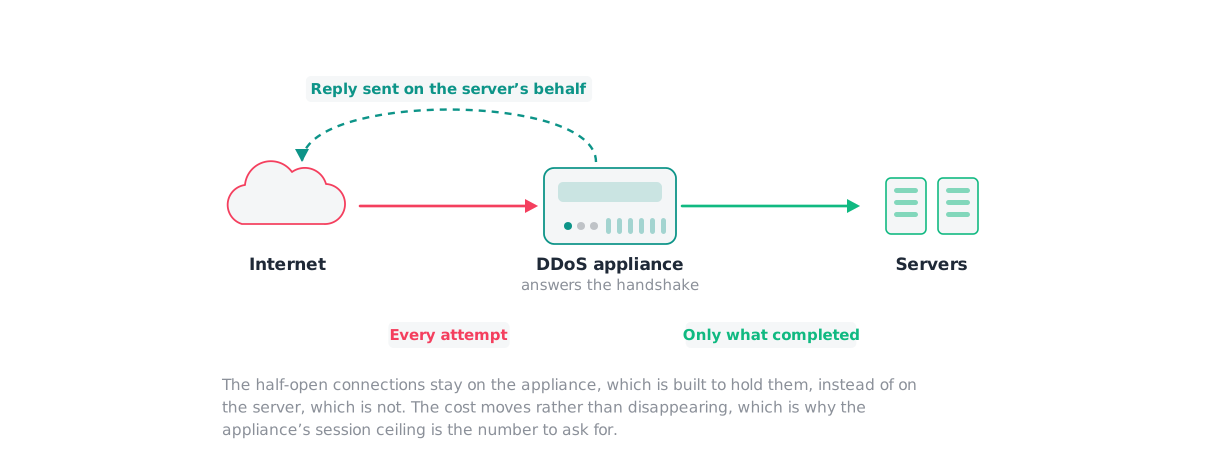
A SYN proxy completes the handshake on behalf of the server and only creates a real session once the client proves it is genuinely there. SYN cookies achieve something similar without a table, by encoding the connection state into the sequence number and reconstructing it when the client answers — trading some TCP option fidelity for having no table to exhaust.
A TCP server that receives a SYN allocates something and waits. That allocation is the point of the attack: send SYNs that never complete, from addresses that do not answer, and the table of half-open connections fills with entries that will never become sessions RFC 4987.
The insight behind both defences on this page is the same. Refuse to allocate anything until the client has proved it is really there.

The two approaches
| Appliance | Holds state before proof | TCP option fidelity | Where it usually lives |
|---|---|---|---|
| Unprotected server | Yes — one entry per SYN | Full | The server itself |
| SYN cookies | No — state encoded in the sequence number | Reduced; some options cannot be carried | Server kernel, as a fallback under pressure |
| SYN proxy | On the protecting device, not the server | Full, if the proxy is faithful | Inline mitigation device or load balancer |
The first column is the whole defence. Everything else is a consequence of refusing to allocate anything until the client has answered.
SYN cookies
Instead of storing the half-open connection, the server encodes what it would have stored into the initial sequence number it sends back. If the client is real it answers, and the answer carries that number back — from which the server reconstructs the state and creates the session. If the client never existed, nothing was allocated and nothing needs cleaning up.
The cost is fidelity. Some options negotiated in the original SYN cannot be reconstructed from a sequence number, and window scaling and selective acknowledgement are the ones that matter RFC 4987. Connections established under cookies can therefore perform worse than normal — which is exactly the right trade during an attack and the wrong default outside one, and why the mechanism engages under pressure rather than always.
SYN proxy
A device in front of the server completes the handshake itself. Only when the client answers does the device establish a session to the server — either by opening a new connection or by splicing the flow. The server never sees a half-open connection at all.
The fidelity is preserved because the proxy is a full participant rather than reconstructing from a hash. The cost is architectural: something is in the path, holding state of its own, with its own capacity limit and its own failure modes.
What they work against
SYN floods, and the family of attacks that consume connection-establishment resources rather than bandwidth. This is the class that most often surprises people who sized their defence in gigabits — a modest packet rate of well-crafted SYNs can exhaust a firewall rated for tens of gigabits, because the constraint is table entries rather than throughput.
What they do not work against
Volume. The packets still arrive. If the flood saturates the circuit, nothing the server or an inline device does with those packets matters.
Completed-handshake attacks. An attacker who completes the handshake and then sends slow or expensive requests has passed the proof these mechanisms demand. That is the application-layer problem, answered by request timeouts, concurrency limits and rate limiting rather than here.
Attacks on the proxy itself. A SYN proxy holds state for every handshake it completes, so an attacker who completes handshakes and abandons them has moved the exhaustion target rather than escaping it.
Operational risk
Cookies engaging silently. Most kernels enable cookies as a threshold-triggered fallback, so the first sign is often a performance complaint rather than an alert. Monitor the counter, not just the symptom.
Proxy capacity is a real ceiling. The device is now the connection-establishment bottleneck. Its stated capacity should be verified in connections per second at your traffic mix rather than read from a datasheet.
Splicing subtleties. A proxy that opens a separate connection to the server changes what the server sees as the client address unless the original is preserved. Applications that log or authorise on source address behave differently as a result.
Interaction with anycast and asymmetric paths. A proxy needs both directions of the flow. Designs where the return path bypasses the device break it in ways that look like random connection failures.
False-positive risk
Low for cookies and moderate for proxies, and both mostly show up as degradation rather than blocking. Cookies do not reject legitimate clients; they serve them with reduced options. A proxy can reject clients whose stacks behave unusually, and aggressive per-source connection limits layered on top of it are where genuine false positives appear.
The number to measure is connection success rate for legitimate traffic while the defence is engaged, which is a specific case of the goodput measurement the proof-of-concept methodology sets out.
How to verify
- Flood SYNs that never complete and confirm the server’s half-open count stays flat.
- Establish legitimate connections through the same path during the flood and measure success rate and latency.
- Check whether window scaling and SACK survive — that tells you whether you are proxying or falling back to cookies.
- Confirm what the server logs as the client address.
- Push the proxy to its connection-establishment ceiling deliberately and record what happens at the limit.
Sources
Frequently asked questions
- Which is better, SYN cookies or a SYN proxy?
- They solve the same problem at different places and with different costs. Cookies are free, always available in modern kernels and cost some TCP option fidelity when they engage. A proxy keeps full fidelity and moves the burden onto a device built for it, at the cost of that device being in the path. A well-built estate usually has both: the proxy as the designed defence, cookies as the fallback that engages if the flood reaches the server anyway.
- What does "reduced option fidelity" actually cost?
- Because the state is reconstructed from the sequence number rather than remembered, some TCP options negotiated in the original SYN cannot be carried across. Window scaling and selective acknowledgement are the ones that matter for throughput on long or lossy paths. The practical effect is that connections established while cookies are engaged may perform worse than normal — acceptable during an attack, which is why cookies are a pressure valve rather than a default.
- Do SYN cookies mean we do not need anything else?
- No. Cookies protect the connection table and nothing else. The packets still arrive, so bandwidth and packet-processing budget are still consumed, and a flood large enough to saturate the circuit is unaffected by what the server does with it.
- How do we tell whether a product is proxying or just rate-limiting?
- Test it. Send a flood of SYNs that never complete and watch whether the server sees any of them: a true proxy answers on the server's behalf and the server sees nothing until a handshake completes. Then send legitimate connections through the same path and confirm window scaling and SACK survive, which tells you whether it is proxying faithfully or falling back to cookies itself.
Sources
- RFC 4987 — TCP SYN Flooding Attacks and Common Mitigations
IETF · 2007-08 · standard · accessed 2026-08-15
The canonical description of the attack and of each countermeasure with its stated trade-offs, including the option-fidelity cost of cookies.
- RFC 4732 — Internet Denial-of-Service Considerations
IETF · 2006-11 · standard · accessed 2026-08-15
Published: August 2026 · Last reviewed: August 2026
Reviewed means the sources above were re-read on that date; the text is only reissued when something material changed.
This guide is updated as vendors release new models and pricing. How we compare vendors