Architecture
Firewall, IPS, WAF or DDoS Appliance: Which Control Owns Which Failure
Last updated: August 2026 · Which control owns which failure · Reading time ~14 min

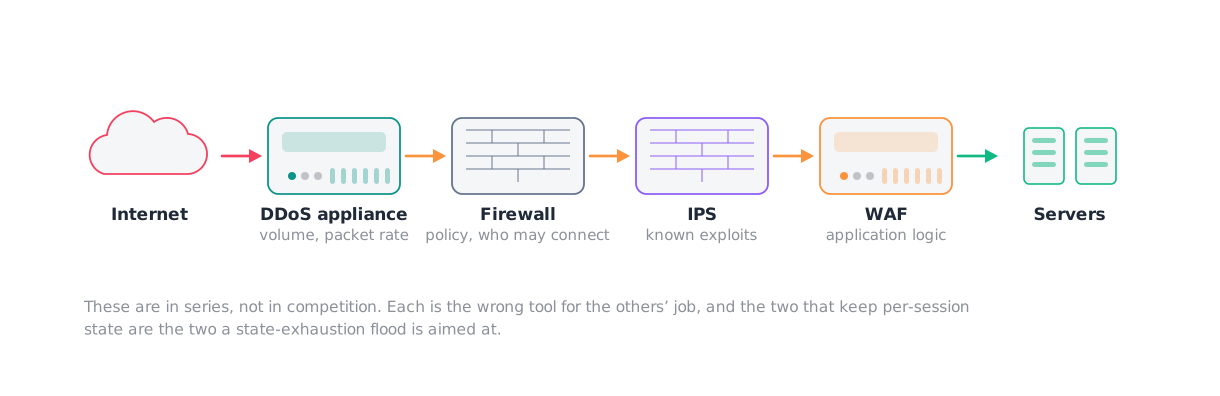
A firewall holds state for every session it permits, which is the resource a state-exhaustion attack sets out to consume — under that class it is a target, not a defence. A WAF inspects requests it has already accepted, so it genuinely overlaps with application-layer abuse and is irrelevant to floods that never complete a handshake. Dedicated mitigation decides about traffic before committing resources to it.
Most arguments about whether a firewall can “do DDoS” are really arguments about which resource an attack consumes, and they resolve immediately once that question is asked explicitly. Denial of service is resource exhaustion RFC 4732, and each control in the path holds a different resource. The control that owns the resource under attack is the one that fails.

The boundary in one table
| Appliance | Holds per-session state | Answers volumetric floods | Answers state exhaustion | Answers application-layer floods |
|---|---|---|---|---|
| Router or upstream filtering | No | Yes, before your circuit | Partly, bluntly | No |
| Firewall | Yes — this is the target | No | No — it is what fails | Partly, if it proxies |
| IPS | Yes | No | No | Only known signatures |
| WAF | Yes, after termination | No | No | Yes, for accepted requests |
| Dedicated DDoS mitigation | Deliberately minimal | Up to its own capacity | Yes — the design centre | Depends on the product |
Read the second column downward: only one row answers saturation, and it is the one that is not in your building. That is the constraint no purchase removes.
Why a firewall becomes the target
A stateful firewall exists to remember. For every session it permits it holds an entry — addresses, ports, sequence state, timers — and that table is finite. It is also the thing a state-exhaustion attack is designed to fill.
This is why the capacity numbers mislead so reliably. A firewall rated for tens of gigabits of throughput can be taken out by a few hundred megabits of well-chosen packets, because the constraint being attacked is not bandwidth. Half-open connections consume slots without ever completing; ACK floods make the device look up sessions that do not exist; fragmentation fills reassembly buffers. None of these need volume.
The firewall’s flood defences are real and worth enabling: SYN cookies avoid allocating an entry until the client proves it is there, aggressive session ageing recovers slots faster, per-source connection limits bound one source’s share. What none of them change is that the defence and the target are the same device, and that under sufficient pressure the device stops forwarding legitimate traffic as well.
A dedicated mitigation layer differs on exactly this axis: it is built to decide about traffic without first committing per-session state to it. That is the whole architectural argument, and it is checkable rather than rhetorical.
What an IPS is and is not for
An intrusion prevention system inspects traffic for known malicious patterns. It addresses exploitation — someone trying to break in — rather than availability, and it holds state to do it, which means it shares the firewall’s exposure to exhaustion.
It belongs in the estate. It does not belong in this conversation except as one more stateful device that needs something in front of it.
What a WAF genuinely overlaps with
The overlap between a web application firewall and application-layer DDoS defence is real and frequently understated by both camps.
A WAF sits after the TCP handshake and after TLS termination, examining complete requests. That position lets it do things no network-layer device can: recognise an expensive endpoint being hammered, apply per-client rate limits with application context, challenge a suspicious client, distinguish a scraper from a browser.
The same position is why it is irrelevant to a SYN flood. A request that never completes a handshake never becomes a request, and a WAF only ever sees requests. Traffic that exhausts the connection table upstream of it has already produced the outage before the WAF had an opinion.
The honest summary is that a WAF and a dedicated mitigation layer overlap at Layer 7 and do not overlap at all below it, and that in a large estate both frequently exist for exactly that reason.
The router and the upstream
The controls furthest from your servers are the only ones that address the failure closest to physics.
Ingress filtering at network borders RFC 2827 limits the spoofed sources that make reflection possible — it protects others from your network rather than your network from others, which is why it remains unevenly deployed and why it is a shared obligation rather than a product feature.
Blunt upstream instruments — remotely triggered black hole filtering RFC 5635, FlowSpec rules — stop saturation reaching your circuit at the cost of dropping some or all traffic to a destination. They are the tools of last resort, and having rehearsed them matters more than having documented them.
Nothing you install in your own rack substitutes for either.
When a flood-protection feature is enough
There is a real answer here and it is not always “buy the appliance”.
A feature on an existing device is enough when your exposure is moderate rather than targeted, when the attacks you actually see are volumetric and your upstream handles them, when your application layer is behind a CDN with the origin concealed, or when your circuit is small enough that anything serious saturates it regardless of what sits behind.
It stops being enough when the attacks are shaped rather than large — state exhaustion, low-and-slow, application-layer requests that are individually valid — because those are aimed at the resource the feature’s host is running on.
When a dedicated appliance is the wrong purchase
Worth saying plainly, because the category rarely does.
For an estate that lives entirely inside one hyperscaler, native controls see the traffic and an appliance mostly does not; buying one is frequently a way to spend capital on a layer that never gets to make a decision.
For a small organisation whose whole exposure sits behind a CDN, with a properly concealed origin, the CDN is the mitigation and a second layer adds operational burden without adding coverage.
For an organisation with no capacity to operate it, an appliance in default configuration is a device that will be blamed after the incident rather than one that prevents it.
The appliance conversation becomes right when traffic reaches infrastructure you operate, when you need the decision made locally, when you have to hold the evidence, or when the application layer is your actual exposure.
Layering, in the order the failures arrive
- Upstream capacity answers saturation. Nothing else does.
- Dedicated mitigation answers state exhaustion and, depending on the product, the application layer.
- The WAF answers application-layer abuse among requests that were accepted.
- The firewall and IPS do their own jobs, protected by the layers above rather than defending against this class.
- Host and platform tuning raises the floor under all of it — the layer covered in the hardening section, and the cheapest thing on this list.
A design that skips level one and buys level two has bought a device that will make correct decisions until the circuit fills. A design that has level one and nothing else will absorb volume and lose to a hundred megabits of well-shaped packets.
What to establish before deciding
Which attack classes have actually reached you, and which resource each one consumed. What your smallest circuit in the path is. Whether your firewall’s session table has ever been the constraint. Whether your application layer is exposed directly or behind something. And who would operate a new layer, at 3am, in the second year.
The proof-of-concept methodology turns those into measurements. The cloud, on-premises and hybrid comparison turns the measurements into a shape.
Sources
Frequently asked questions
- Our firewall datasheet lists DDoS protection. Is that enough?
- It depends entirely on which attack class you are worried about, and the answer is structural rather than a matter of quality. Firewall flood defences — SYN cookies, aggressive session ageing, per-source connection limits — genuinely help against moderate floods. What they cannot change is that the firewall holds state for every permitted session, so an attack designed to fill that table attacks the same resource the defence runs on. If your exposure is state exhaustion, the feature is a mitigation on the target rather than a defence in front of it.
- Does a WAF protect against DDoS?
- Against the part that reaches it. A WAF inspects requests after the session has been accepted and terminated, which makes it useful against application-layer abuse and structurally irrelevant to floods that never complete a handshake — those exhaust something upstream of it. Dismissing its application-layer value is as much a mistake as treating it as a DDoS defence.
- When is a dedicated DDoS appliance unnecessary?
- More often than the category admits. If your estate lives entirely inside one hyperscaler, the native controls see traffic an appliance never will, and an appliance is frequently the wrong purchase. If your exposure is a small site behind a CDN with the origin properly concealed, the CDN is doing the work. If your circuit is small enough that any serious attack saturates it regardless, the money belongs upstream. An appliance earns its place when traffic reaches infrastructure you operate and you need the decision, the evidence or the latency locally.
- Where does an IPS fit?
- Largely outside this problem. An IPS looks for known malicious patterns in traffic it processes, which addresses exploitation rather than availability. It also holds state, so it shares the firewall's exposure. Useful control, different failure.
- If we buy a DDoS appliance, can we stop tuning the servers?
- No, and the reason is worth stating precisely: host tuning decides whether a moderate flood is an incident or a graph, which is the range most attacks actually fall into. An appliance raises the ceiling; kernel, web-server and application-server limits raise the floor. Neither substitutes for the other, and the hardening layer is cheap.
Sources
- RFC 4732 — Internet Denial-of-Service Considerations
IETF · 2006-11 · standard · accessed 2026-08-15
The framing of denial of service as resource exhaustion, which is what makes the firewall's state table a target rather than an asset.
- RFC 2827 (BCP 38) — Network Ingress Filtering
IETF · 2000-05 · standard · accessed 2026-08-15
- RFC 5635 — Remote Triggered Black Hole Filtering with uRPF
IETF · 2009-08 · standard · accessed 2026-08-15
Published: August 2026 · Last reviewed: August 2026
Reviewed means the sources above were re-read on that date; the text is only reissued when something material changed.
This guide is updated as vendors release new models and pricing. How we compare vendors