Architecture
Inline or Out-of-Path, Always-On or On-Demand
Last updated: August 2026 · Two axes, four combinations · Reading time ~14 min

These are two independent axes, not one choice. Inline or out-of-path decides whether the device is in the failure domain of your traffic. Always-on or on-demand decides how much time passes before mitigation begins. An inline device can be run in monitoring mode, and an out-of-path device can divert automatically — so the honest question is what each combination costs you on a normal day and on a bad one.
These two decisions are routinely discussed as one, usually because a supplier’s product happens to combine them in a particular way. They are independent, and separating them makes both easier to reason about.
Inline or out-of-path is a question about topology: does traffic pass through the device?
Always-on or on-demand is a question about timing: is mitigation applied continuously, or started when something is detected?
An inline device can sit in the path and do nothing until told to act. An out-of-path device can have traffic permanently diverted to it. All four combinations exist.

At a glance
| Appliance | Combination | Time to mitigation | What it costs |
|---|---|---|---|
| Inline, always-on | Immediate; the device is already in the path | The device is in the failure domain of all traffic, always | |
| Inline, on-demand | Fast; enforcement is a policy change, not a route change | Same failure domain, plus a detection delay by choice | |
| Out-of-path, on-demand | Detection plus diversion, typically minutes | Traffic is unprotected until diversion completes | |
| Out-of-path, always-on | Immediate, but only for what is permanently diverted | A permanent detour, with its latency and its own dependency |
Two of these four are common, one is a deliberate posture, and one is a contradiction people still buy. Read the second column against your own tolerance before reading the third.
The topology axis
Inline means the device is in the traffic path and sees every packet in both directions if the routing is symmetric. It can act on any packet immediately, because it is already holding it.
The cost is a failure domain. Everything that passes through the device depends on the device, every day, including the overwhelming majority of days with no attack. Hardware bypass reduces this to a brief interruption on power loss, and software faults are less reliably covered by it. This is why bypass mechanism, trigger conditions and measured failover time are specification items rather than details.
Inline also sees packets, which is the requirement for anything that inspects content or tracks protocol behaviour closely.
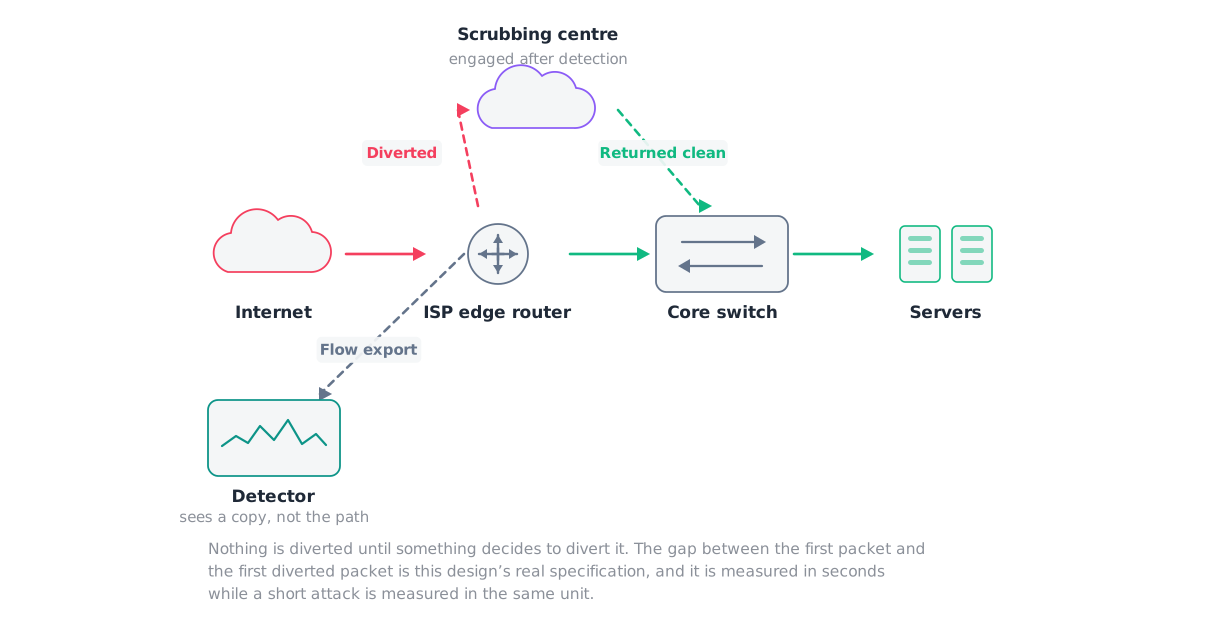
Out-of-path means the device sits beside the traffic. Detection normally comes from exported flow records — IPFIX or an equivalent — and mitigation requires redirecting traffic to the device, or pushing a filter upstream, before anything can be cleaned.
The cost is what flow records cannot show. Volumes, source distributions and protocol mixes are visible in excellent detail. Packet content is not, and neither is the fine-grained protocol behaviour that application-layer detection depends on. The granularity of the export sets a floor on what can be detected at all.
The benefit is that on an ordinary day the device is not in anyone’s path, which removes it from the failure domain entirely.
The timing axis
Always-on means mitigation is applied continuously. There is no detection delay before enforcement, because enforcement never stopped. The cost is whatever the mitigation itself imposes on normal traffic: added latency, connection-handling changes, and a false-positive rate that is now permanent rather than occasional.
On-demand means normal traffic passes untouched and mitigation begins when something is detected. The cost is the window: detect, decide, act. For an out-of-path design that window includes route convergence, which is where minutes come from rather than seconds.
That window is exactly what pulse attacks exploit. Short repeated bursts, each ending before the loop closes, can deny service continuously while a diversion-based defence never quite engages. An estate exposed to that pattern should be honest about whether its architecture can respond at all.
The four combinations
Inline, always-on. Immediate action, permanent failure domain, permanent cost on normal traffic. The right answer where time-to-mitigation dominates and the bypass path is trusted.
Inline, on-demand. The device is in the path but passive until needed, so acting is a policy change rather than a route change. Fast, and it keeps the false-positive cost off ordinary days. The failure domain is unchanged, which is the part people forget: the risk of being inline is paid whether or not the device is enforcing.
Out-of-path, on-demand. The classic scrubbing arrangement, described in diversion, cleaning and return. No everyday failure domain, no everyday latency cost, and a detection-plus-diversion window during which traffic is unprotected. Suits estates whose exposure is large volumetric events and whose tolerance for a few minutes of degradation is real.
Out-of-path, always-on. Traffic is permanently diverted through a device that is nominally beside the path. This can be sensible when the detour is short and the operator wants a consistent enforcement point, and it is a contradiction when it is bought for the failure-domain benefits of out-of-path while paying the detour cost of always-on. Ask what the detour costs in latency and what happens when the diversion path itself fails.
Deciding
Four questions, in order:
- What is the tolerable time to mitigation? If it is seconds, out-of-path on-demand is already excluded and the conversation is short.
- What is the tolerable everyday risk? An inline device is a dependency on days when nothing is attacking. Establish the bypass behaviour before accepting it.
- What must be detected? Application-layer attacks need packets, which means inline or diverted. Volumetric attacks are visible in flow records.
- Does the exposure include pulses? If it does, a diversion window measured in minutes is not a defence against it.
Most substantial estates end up with both layers rather than one: an inline stage sized to the circuit for what arrives, and an upstream diversion arrangement for what would fill it. The division and its economics are worked through in cloud, on-premises or hybrid, and the sizing arithmetic for the inline half in capacity sizing.
Frequently asked questions
- Is inline always faster to mitigate?
- Faster to *act*, yes, because there is no diversion step. Faster to *decide* is a separate question that depends on detection, and an inline device with a slow detection loop can be beaten by an out-of-path design with fast flow analysis and pre-armed diversion. Ask for time-to-mitigation as a measured figure rather than inferring it from the topology.
- What is the real risk of an inline device?
- That it becomes a failure domain for traffic it is not currently protecting — on a quiet Tuesday with no attack in sight. Hardware bypass and a fail-open path reduce this to a short interruption, which is why the bypass mechanism, its trigger conditions and its measured failover time belong in the specification rather than in a conversation.
- Does out-of-path mean the appliance sees less?
- Usually yes, and that is the trade. Out-of-path detection typically works from exported flow records rather than packets, which gives excellent visibility of volumes and distributions and very little of packet content. Volumetric and protocol-layer attacks show up clearly; application-layer attacks that are normal in volume often do not.
- Can on-demand diversion be made automatic?
- It can, and whether it should be is the same argument as any other automation question: the diversion has a cost, so a false trigger has a cost. Most mature estates automate diversion for clear volumetric signatures and keep a human in the loop for ambiguous ones, with the thresholds written into the escalation matrix rather than left to judgement.
Sources
- RFC 5635 — Remote Triggered Black Hole Filtering with Unicast Reverse Path Forwarding
IETF · standard · accessed 2026-08-17
The mechanism most on-demand designs use to redirect or discard traffic upstream.
- RFC 8955 — Dissemination of Flow Specification Rules
IETF · standard · accessed 2026-08-17
- RFC 7011 — Specification of the IP Flow Information Export (IPFIX) Protocol
IETF · standard · accessed 2026-08-17
Flow export is what an out-of-path detector sees instead of packets, and its granularity sets the detection floor.
Published: August 2026 · Last reviewed: August 2026
Reviewed means the sources above were re-read on that date; the text is only reissued when something material changed.
This guide is updated as vendors release new models and pricing. How we compare vendors