Architecture
Local Detection or Cloud-Dependent Detection: What Changes
Last updated: August 2026 · Which functions stop when the feed is gone · Reading time ~15 min

The question is not whether a product uses cloud intelligence but which functions stop without it. A device that enriches local decisions with an external feed keeps working when the feed is unreachable; a device that computes the decision externally does not. The difference is invisible in a demonstration and decisive in an incident, so it is established by disconnecting the path and repeating the attack, not by reading a description.
Every DDoS product does two separable things: it works out that traffic is hostile, and it does something about it. Marketing treats these as one capability. Architecture does not, and the seam between them is where products differ most and describe themselves least.
The question is not whether a product uses cloud intelligence. Nearly all of them do, sensibly. The question is which functions stop when it cannot be reached.

At a glance
| Appliance | Architecture | Where the decision is computed | What a lost external path costs |
|---|---|---|---|
| Fully local | On the device, from its own observations | Nothing in detection; updates and support stop | |
| Local with external enrichment | On the device, informed by a downloaded feed | Feed ages; detection continues on local evidence | |
| Split decision | Externally, enforced locally | Classification stops; enforcement continues on last-known policy | |
| Fully external | In the provider's network, where traffic is also cleaned | Traffic is not being cleaned at all |
None of the four is wrong. They fail differently, and a buyer's job is to know which failure the estate can survive rather than to prefer one architecture in the abstract.
Four architectures, not two
The industry frames this as local versus cloud. There are four positions, and most confusion comes from products in the middle two describing themselves as if they were in the first.
Fully local. The device observes your traffic, builds its own picture of normal, and decides. Nothing outside the estate participates in a drop decision. Software updates and support still require a supplier, as they do for every product ever sold, but no live service sits in the decision path.
Local with external enrichment. The decision is computed on the device, using local observation plus data downloaded periodically — reputation lists, attack signatures, geographic databases. If the download fails, the data ages. Detection does not stop; it becomes gradually less current.
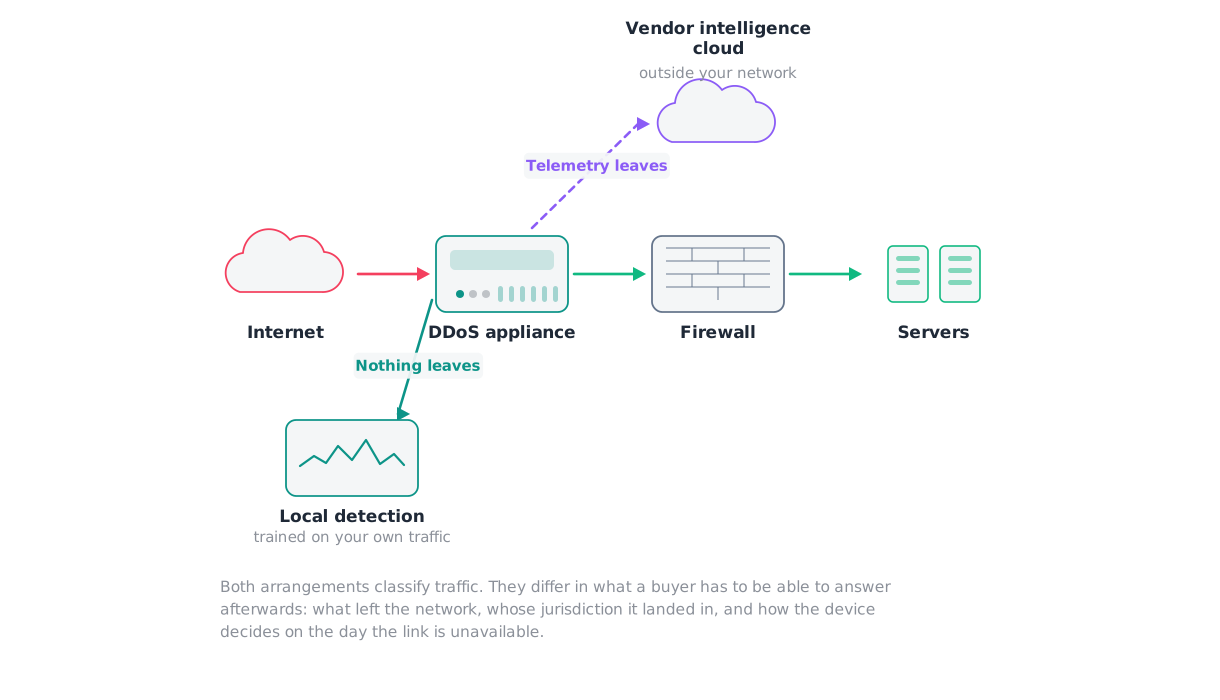
Split decision. Analysis happens externally — telemetry is exported to a service that determines what is hostile — while enforcement happens on local hardware. Lose the path and enforcement continues against whatever policy was last installed, but nothing new is classified. This architecture is common and is frequently described using the same language as the first two.
Fully external. Traffic is diverted to a provider’s network, where it is both classified and cleaned. Losing the path does not degrade detection; it means traffic is not being protected at all, and this is well understood by everyone who buys it.
What actually changes
Time to a decision
Local classification decides in the time it takes to process a packet. Split-decision architectures decide at the speed of a round trip plus analysis, which is fine for a slow-building volumetric attack and poor for a burst that is over before the loop closes. Pulse attacks — short, repeated bursts — exist partly because they exploit this gap.
Where the external path is long, this compounds. An estate whose international transit is thin inherits that latency in its defence, which is the specific reason the thin-transit case treats decision locality as an availability question rather than a preference.
Behaviour when the path fails
This is the property that matters most and is demonstrated least, because a demonstration happens on a working network.
The failure that concerns you is rarely the provider going down. It is your own transit degrading — during an attack, which is exactly when the dependency is needed. An architecture whose classification requires a healthy path to the outside has that requirement satisfied least reliably at the moment it matters most.
Novel vectors
Here the advantage genuinely runs the other way. A device that has only ever seen your traffic learns your normal well and knows nothing about an attack pattern first seen elsewhere last week. A shared view across many networks sees it and can distribute the knowledge.
For a well-known vector this is worth little; SYN floods have not changed and every product handles them. For a novel application-layer pattern it can be worth a great deal. A buyer who dismisses external intelligence is discarding something real.
What leaves the network
Split-decision and fully external architectures require traffic characteristics to travel to the analysing party. What travels varies enormously — flow records summarising volumes are a different proposition from full packet payloads — and the difference is rarely stated without being asked.
Where a data-residency regime applies, this converts an architectural choice into a compliance question, which is the ground the GCC residency analysis works through in detail. Under DORA the same dependency appears again as third-party concentration risk: a defence that requires an external service has added that service to the list of things your availability depends on.
The questions that separate them
Ask about functions, not about products. Nearly every product answers a whole-product question in whichever way is most favourable, and every one of them can do so honestly, because most are mixtures.
- Which specific detection functions require reachability to a service you operate?
- If that reachability is lost, which continue unchanged, which degrade, and which stop?
- Is a licence or entitlement check in the decision path, and what is its failure mode?
- What data leaves the estate for classification, in what form, to which jurisdiction, and with what retention?
- How long can the device run disconnected before behaviour changes measurably?
Question 3 catches an architecture that is otherwise local. A device that classifies entirely on its own but stops working when it cannot validate a licence has a cloud dependency in the only place that counts, and this is a genuinely common arrangement that no datasheet describes as a dependency.
Testing it in an afternoon
The measurement is simple enough that there is no excuse for buying this property on trust.
Run a baseline: a representative attack against a representative service, recording drop rate, legitimate-traffic survival and time to mitigation. Then sever the device’s path to the manufacturer — at the firewall, not by unplugging its data path — and repeat the identical run.
Three outcomes, and they are unambiguous:
- Unchanged: classification is local. Note how long the test ran; some architectures degrade after a cached entitlement expires rather than immediately, so a long run tells you more than a short one.
- Gradual degradation: enrichment was lost. Establish over what period the data ages into irrelevance.
- Step change: the decision was being made elsewhere. This is not a defect, but it is now a known property with consequences you can plan around.
The full test structure, including how to keep this legal and safe, is in the proof-of-concept methodology and authorised testing.
Choosing on purpose
An estate whose exposure is volumetric saturation should not be optimising for detection locality, because the upstream tier does the work and where it decides is nearly irrelevant. An estate under a residency obligation, or one whose transit is thin, or one that must keep operating through a degraded international path, is choosing something structural and should know which of the four architectures it has bought.
The mixed answer is usually the right one and is treated properly in cloud, on-premises or hybrid: local decisions for what arrives, an upstream tier for what would otherwise fill the circuit, and a clear understanding of which layer is still functioning when the other is not. What matters is that the arrangement was chosen rather than discovered during an incident.
Frequently asked questions
- Is local detection simply better?
- No, and a page arguing that would be selling something. A shared external view sees attacks before they reach you, correlates sources across many networks and updates faster than any single site can learn — genuine advantages that a purely local device does not have. What local decision-making buys is not superior classification but predictable behaviour when a path fails, and independence from a third party's availability and jurisdiction. Which of those matters more is a property of the estate.
- How do I find out which architecture I actually bought?
- Disconnect the device's path to the manufacturer in a test window, replay the same attack, and compare. Graceful degradation and a step change are different answers and both are visible within minutes. Documentation frequently describes the intended design rather than the enforced one, so measurement settles it and reading does not.
- Does a downloaded reputation or signature feed count as a dependency?
- It is a dependency on freshness, not on availability, and the distinction matters. If the feed cannot be reached the data ages, detection keeps running on what it has, and the consequence accrues over days. If the classification itself is computed elsewhere, the consequence is immediate. Ask which of the two describes each function separately — most products are a mixture and answer for themselves as a whole.
- What does this have to do with data residency?
- Detection that runs elsewhere requires traffic characteristics to travel there. Whether that is a compliance problem depends on what is sent — flow records and header summaries are a different matter from full packets — and on the regime you are under. The question to put in writing is precisely what leaves, in what form, to which jurisdiction, and with what retention.
Sources
- RFC 4732 — Internet Denial-of-Service Considerations
IETF · 2006-11 · standard · accessed 2026-08-16
- RFC 9132 — Distributed Denial-of-Service Open Threat Signaling (DOTS) Signal Channel Specification
IETF · standard · accessed 2026-08-16
A standardised signalling channel between an enterprise and a mitigator, including its behaviour when the channel is lost.
- Regulation (EU) 2022/2554 (DORA)
EUR-Lex · 2022-12-14 · regulator · accessed 2026-08-16
Third-party ICT dependency and concentration risk, which is what an external detection dependency creates.
- The NIST Cybersecurity Framework (CSF) 2.0
NIST · standard · accessed 2026-08-16
Published: August 2026 · Last reviewed: August 2026
Reviewed means the sources above were re-read on that date; the text is only reissued when something material changed.
This guide is updated as vendors release new models and pricing. How we compare vendors