Architecture
What Happens to Your DDoS Protection If the Vendor's Cloud Goes Offline?
Last updated: August 2026 · Which components fail closed, and when · Reading time ~13 min

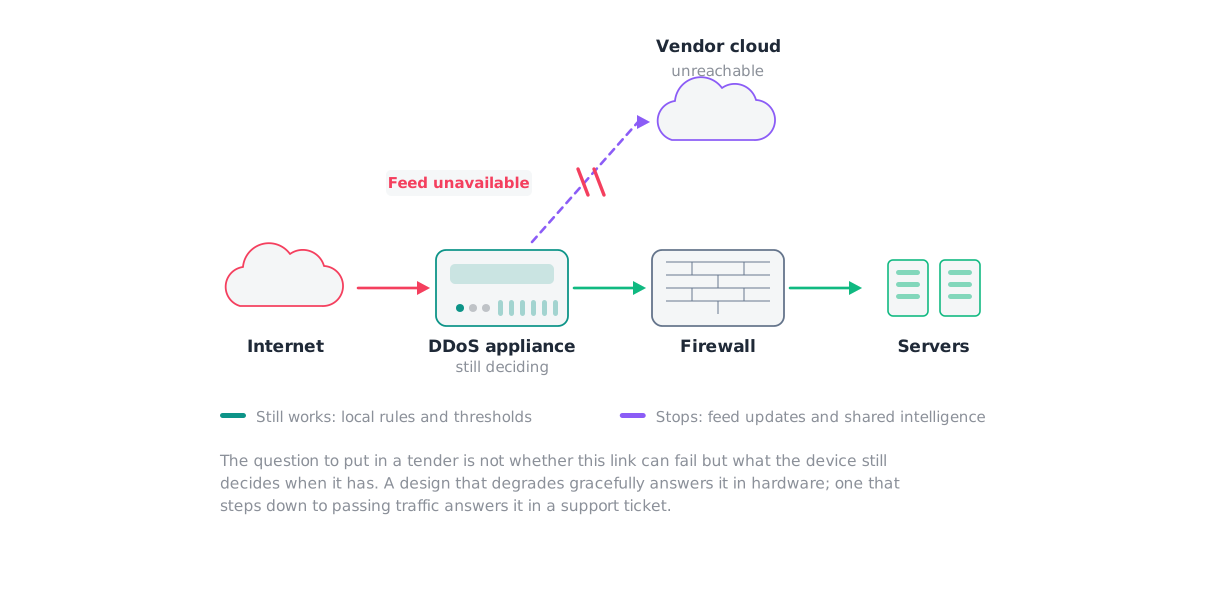
A DDoS defence can be architecturally local and still stop working when a supplier is unreachable, because the dependency is usually not in detection but in licence validation, entitlement or the management plane. The property to specify is fail-operational: on losing every external path, the device keeps enforcing its last known good policy and degrades in function rather than ceasing. Ask which components fail closed, and require the answer in writing.
Aviation and industrial control settled this vocabulary decades ago. A system that stops safely when something fails is fail-safe. A system that keeps performing its function in a degraded form is fail-operational. A brake is designed to be the first; a flight control surface has to be the second.
A DDoS defence is a flight control surface. It is needed precisely when conditions are abnormal, and a defence that ceases when something upstream of it is unreachable has chosen the wrong failure mode for the job it does.
The uncomfortable part is that most buyers never establish which they bought, because the question is not on any datasheet and does not come up in a demonstration.

At a glance
| Appliance | Component | Typical failure mode when unreachable | What to require instead |
|---|---|---|---|
| Classification service | New traffic is not classified; policy freezes | Local classification, or a documented frozen-policy behaviour | |
| Licence or entitlement check | Can fail closed and stop enforcement | A grace period measured in weeks, stated in the contract | |
| Management plane | Policy cannot be changed during the incident | A local administrative path independent of the hosted console | |
| Signature and reputation updates | Data ages; no immediate loss | Nothing; this is the acceptable dependency | |
| Telemetry and reporting | Incident evidence is not retained anywhere you control | Local retention sufficient for your reporting deadline |
Only the fourth row is a dependency worth accepting without argument. The other four decide whether a defence is still a defence on the day the supplier has a bad afternoon.
The dependency is usually not where you look for it
Where detection runs is the question most buyers ask, and it is the right question. It is also, for on-premises products, frequently not the one that bites.
A device can classify entirely on its own hardware, using its own observations, with no external analysis whatsoever — and still stop enforcing when it cannot validate a licence. The classification architecture is genuinely local. The product is not.
This arrangement is common, rarely documented as a dependency, and almost never surfaced in a tender, because the tender asked about detection and the answer about detection was true.
Four things that can be unreachable
The classification service. Covered separately, because it is the one everybody thinks about. If analysis happens elsewhere, losing the path freezes policy at its last state.
The licence or entitlement check. The one that matters most and is asked about least. Software that validates its right to run against a hosted service has to decide what to do when the service does not answer, and there are three possible answers: continue indefinitely, continue for a grace period, or stop. All three exist in this product category. Only the first two are compatible with a defence.
The management plane. Increasingly the console is hosted rather than on the device. This is convenient and generally sound, and it means that when the hosted console is unreachable you may be unable to change a policy — during the incident that made you want to change it. The question is whether a local administrative path exists at all, not whether the hosted one is reliable.
Update and telemetry paths. Signature and reputation feeds age gracefully and are the one dependency worth accepting without argument. Telemetry export is different: if incident records live only in a hosted system, an outage that coincides with an attack costs you the evidence for a reporting deadline as well as the protection.
Why the compound probability is not small
The supplier having an outage is the least likely route to this condition, and treating it as the scenario is why the risk gets dismissed.
The realistic routes are ordinary. International transit degrades under the attack itself — this is the case that should worry anyone, because the dependency fails at exactly the moment it is needed. A firewall change severs an outbound path that nobody documented as load-bearing. A certificate expires. An entitlement lapses because a renewal purchase order sat in an approvals queue for three weeks.
Each of these produces the same state as a supplier outage. Over a five-year term, the probability that none of them occurs is not the number people assume when they wave the risk away.
What to require, in writing
The specification language is short, and it is worth putting in the contract rather than the questionnaire:
On loss of connectivity to all supplier-operated services, the appliance shall continue to enforce its last known good policy for a period of not less than N days, shall remain administrable through a local interface, and shall retain incident telemetry locally for not less than M days. The supplier shall state, per function, what degrades during this period.
Three numbers and one obligation. N should cover a procurement delay. M should cover the reporting deadline that applies to you — under NIS2 or DORA that is a defined period, not a matter of preference.
The final clause is the load-bearing one. A supplier willing to enumerate what degrades has thought about it. A supplier who answers that nothing degrades has usually not tested it.
Testing it properly
The test is easy to run and easy to run badly.
Block the appliance’s outbound path to the supplier at the perimeter — not by unplugging its data path, which tests something else entirely — and then leave it blocked. The duration is the whole test. Grace periods are timers; a device disconnected for an hour behaves identically whether the grace period is two days or ninety, and a short test therefore proves nothing about the property you are trying to measure.
Run the attack scenarios at the start of the window and again at the end. Watch for the second run to differ from the first, which is the signature of an expiring entitlement rather than a lost feed.
Where a full window is not available, require the behaviour contractually instead. An untested contractual term is weaker than a measurement and much stronger than an assumption.
The honest position
None of this argues for avoiding suppliers with cloud components, which would be an argument against most of the category and against several genuinely good products. A hosted console is better than a neglected local one. A shared intelligence feed sees things your network cannot.
What it argues for is knowing which components are in the enforcement path, because a dependency you have chosen is a risk you can plan around and a dependency you discovered during an incident is an outage. The same reasoning applied to supplier jurisdiction rather than supplier availability is worked through in vendor jurisdiction risk, and the extreme case — environments where no external path is permitted at all — is air-gapped mitigation.
Frequently asked questions
- Is this a realistic risk or a hypothetical one?
- The supplier's own outage is the least likely of the paths to it. Far more common are your international transit degrading during an attack, a firewall rule change severing an outbound path nobody documented, a certificate expiring, or an entitlement failing to renew because a purchase order was late. Each produces the same condition as a supplier outage, and the compound probability across all of them over a five-year term is not small.
- What is a reasonable licence grace period to ask for?
- Long enough to survive a procurement delay, which in most organisations means weeks rather than hours. The specific number matters less than having one that is written down and testable. A supplier who cannot state the behaviour has usually not decided it, which means it is whatever the code happens to do.
- Does this argue against cloud-delivered DDoS protection?
- No. A fully cloud-delivered service has this dependency by design and everybody understands it, which makes it a manageable risk rather than a hidden one. The dangerous case is the on-premises appliance believed to be self-contained that turns out to have a hosted licence check in the enforcement path — a dependency with none of the benefits of a cloud service and all of the exposure.
- How do I test the licence behaviour without breaking production?
- In the proof of concept, not in production. Ask for the entitlement path to be blocked on the evaluation unit and leave it blocked for the length of the test window rather than for an hour, because grace periods expire on a timer and a short test will pass regardless. If the evaluation cannot be arranged, require the behaviour and the grace period as a contractual term.
Sources
- Regulation (EU) 2022/2554 (DORA)
EUR-Lex · 2022-12-14 · regulator · accessed 2026-08-16
Third-party ICT risk, concentration, and exit strategies — the regulatory frame for the questions below.
- Directive (EU) 2022/2555 (NIS2)
EUR-Lex · 2022-12-14 · regulator · accessed 2026-08-16
Supply-chain security as an obligation of the entity rather than of its supplier.
- SP 800-61 Rev. 3 — Incident Response Recommendations and Considerations for Cybersecurity Risk Management
NIST · standard · accessed 2026-08-16
Published: August 2026 · Last reviewed: August 2026
Reviewed means the sources above were re-read on that date; the text is only reissued when something material changed.
This guide is updated as vendors release new models and pricing. How we compare vendors