Attack class
ICMP Flood
Last updated: August 2026 · Easy to bound, easy to over-mitigate · Reading time ~8 min

An ICMP flood consumes bandwidth and packet-processing budget with messages that require no session and no handshake. It is easy to generate and easy to bound, and the standard mistake is blocking ICMP outright — which breaks path MTU discovery, silently degrades performance for everyone, and removes the diagnostics you will want during the next incident. Rate-limit by type instead.
The ping flood is the attack everyone learns first, and the one whose defence is most often overdone. It has no leverage, no handshake, no state to exhaust: it is simply packets, sent as fast as the attacker can send them.
That simplicity makes the mitigation straightforward and the over-mitigation expensive.

At a glance
| Appliance | ICMP message | Attack use | Safe to block? |
|---|---|---|---|
| Echo request and reply | The classic ping flood | Rate-limit rather than block; diagnostics depend on it | |
| Destination unreachable | Rarely useful to an attacker | No: it carries path MTU information | |
| Time exceeded | Not a flood vector | No: traceroute and loop detection depend on it | |
| Redirect | Can be abused to alter routing | Generally yes, at the network edge | |
| Malformed or truncated | Fragmentation and parser attacks | Yes: no legitimate counterpart |
Only two rows are safe to block outright. The reflex to drop ICMP as a category treats the whole protocol as if it were the first row.
What it exhausts
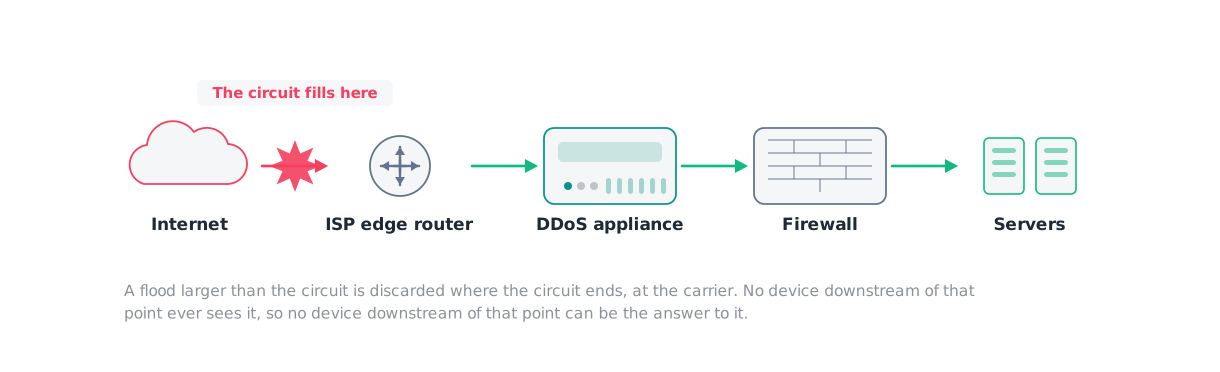
Bandwidth, if the attacker has enough of it, in which case the contest is decided upstream of your circuit like any other volumetric attack.
Packet-processing budget, which is the more common outcome. Small ICMP packets at high rate produce per-packet work on every device in the path, and a device can saturate on packet rate well below the bit rate that would trouble the link.
Reply generation, where hosts answer echo requests. Each request produces a response, so an unprotected host spends outbound capacity as well as inbound.
There is no amplification in a direct flood: the attacker sends what the attacker has. That places it firmly among the attacks bounded by the uplink, and it is why the arithmetic in capacity sizing settles the question quickly.
How it differs from similar attacks
A UDP flood behaves almost identically at the network layer, and the two are frequently generated by the same tools in the same campaign. The difference that matters operationally is that ICMP is a control protocol: some of its messages are load-bearing for ordinary connectivity, and UDP to a closed port is not.
That asymmetry is the whole reason this page exists. The mitigation is the same; the cost of getting it wrong is much higher.
Observable telemetry
- ICMP packet rate rising sharply against a low bit rate.
- Echo requests dominating the ICMP mix, where normally they are a small fraction.
- Outbound echo replies rising in step, on hosts that answer.
- Source distribution either very narrow, indicating a simple tool, or very wide, indicating forged sources.
- Device CPU rising with no change in session counts.
Common false positives
Monitoring systems. Availability monitoring is built on ping, and a system checking many targets frequently produces a legitimate ICMP rate that per-source limits will refuse. Whitelist them before setting limits, not after.
Traceroute and diagnostics. Ordinary troubleshooting produces bursts of ICMP that look anomalous against a quiet baseline.
Path MTU discovery. Legitimate packet-too-big messages arrive in bursts when a path changes, which is precisely when discarding them causes the most damage.
Mitigation by layer
Rate-limit by message type, not by protocol. Echo requests get a ceiling derived from your measured monitoring traffic; control messages are left alone.
Never block the control messages. Destination unreachable and time exceeded carry information that TCP and applications depend on. RFC 4890 sets out the ICMPv6 case explicitly, and the reasoning applies to IPv4.
Disable directed broadcast, which is default on modern equipment and worth confirming rather than assuming.
Upstream rate limiting where the volume approaches the circuit, because at that point nothing on your premises can help. FlowSpec can express a protocol-and-rate match cleanly.
Ingress filtering at network edges reduces the forged sources these floods usually carry — the BCP 38 argument in its simplest application.
Operational pitfalls
Blocking ICMP as a category. The single most common over-correction in this field. It produces intermittent, hard-to-diagnose application failures weeks later, attributed to everything except the firewall rule.
Setting the echo limit from a quiet period. Monitoring systems produce a steady legitimate rate that a limit derived from an idle window will refuse.
Forgetting IPv6. Blanket ICMPv6 filtering breaks neighbour discovery, which breaks the segment rather than degrading it.
Safe validation
Generate an echo flood at increasing rate against a lab target and record the packet rate at which device CPU saturates, the frame size used, and whether legitimate monitoring traffic survived. Then repeat with your intended rate limit in place and confirm the monitoring survived that too.
The second run is the one that matters, because the failure mode of this attack’s defence is refusing your own systems rather than admitting the attack. Isolation requirements are in the test lab guide.
Frequently asked questions
- Should we just block all ICMP at the edge?
- No, and the damage from doing so is real and hard to attribute. Path MTU discovery depends on the packet-too-big message; without it, connections establish and then hang when a large packet is sent, which presents as an intermittent application fault rather than a firewall policy. RFC 4890 sets out which messages must survive filtering.
- How big can an ICMP flood get?
- As large as the attacker's bandwidth, since there is no amplification in a direct ping flood. That makes it a straightforward volumetric problem bounded by your uplink, and it is why the answer lives upstream rather than on your premises.
- What about smurf attacks?
- Largely historical. Smurf used directed broadcast so that every host on a segment replied to a forged source, providing amplification. Directed broadcast is disabled by default on modern equipment, and the technique persists mainly in networks running very old configurations.
- Is ICMPv6 different?
- Considerably, and more dangerous to over-filter. Neighbour discovery, router advertisement and packet-too-big all run over ICMPv6, so blanket blocking does not merely degrade performance — it breaks basic connectivity on the segment.
Sources
- RFC 792 — Internet Control Message Protocol
IETF · 1981-09 · standard · accessed 2026-08-18
The original specification, including the echo request and reply this attack abuses.
- RFC 4890 — Recommendations for Filtering ICMPv6 Messages in Firewalls
IETF · standard · accessed 2026-08-18
The clearest published account of which ICMP messages must not be filtered, and why blanket blocking causes damage.
- RFC 8201 — Path MTU Discovery for IP version 6
IETF · standard · accessed 2026-08-18
Why discarding the packet-too-big message produces a connectivity failure that is very hard to diagnose.
Published: August 2026 · Last reviewed: August 2026
Reviewed means the sources above were re-read on that date; the text is only reissued when something material changed.
This guide is updated as vendors release new models and pricing. How we compare vendors