Attack class
DNS Query Flood
Last updated: August 2026 · Valid questions, more than you can answer · Reading time ~9 min

A query flood sends more valid DNS queries than the server can answer. There is no amplification and nothing malformed, so the only distinguishing features are rate, source distribution and what is being asked for. Because DNS failure takes everything else with it — a service nobody can resolve is a service that is down — it is the highest-leverage single target in most estates.
A DNS query flood has nothing clever in it. The queries are well-formed, the names are usually real, and each one asks a question the server is supposed to answer. There are simply more of them than the server can handle.
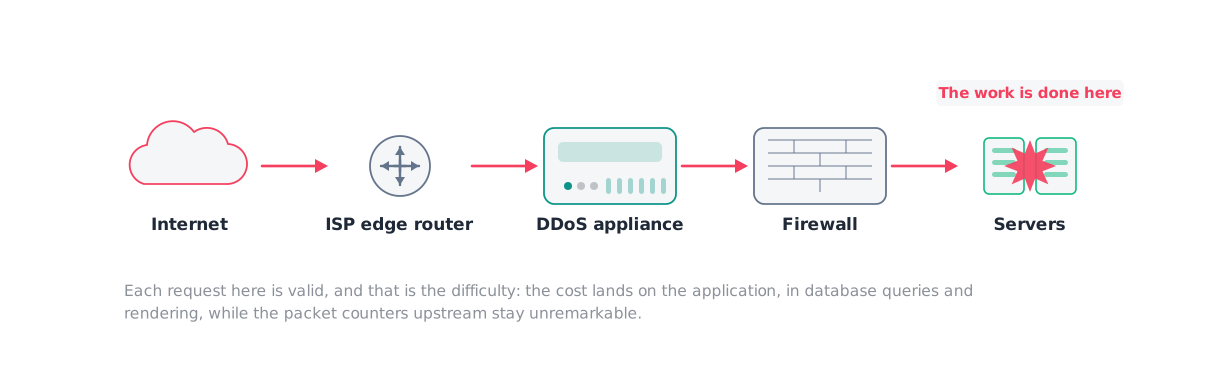
That plainness is the difficulty. There is no malformation to signature, no amplification factor to notice, and no protocol violation to point at — only volume that has to be separated from popularity.

At a glance
| Appliance | Property | Query flood | Water torture | Amplification |
|---|---|---|---|---|
| Queries are for | Names that exist | Random names that do not | Anything with a large answer | |
| Target | Your DNS server | Your DNS server and other resolvers | Somebody else, using DNS as the reflector | |
| Cache behaviour | Cache absorbs much of it | Cache is structurally useless | Not relevant | |
| Distinguishing signal | Rate and source spread | NXDOMAIN ratio | Response size and forged sources |
Three attacks that arrive as DNS traffic and need three different responses. Treating them as one category is why DNS mitigation is so often mis-tuned.
What it exhausts
Query-handling capacity on the server: parsing, lookup and response generation, all of which happen per query.
Bandwidth, though usually less than expected. DNS messages are small, so a query flood can saturate a server long before it troubles a circuit — which means it is frequently a packet-rate problem rather than a volumetric one.
Upstream capacity for recursive resolvers, where a flood of names the resolver has not cached forces it to forward each one.
The consequence is disproportionate. DNS is a dependency of nearly everything else in an estate, so exhausting it produces a total outage from a partial attack.
How it differs from similar attacks
Three attacks arrive as DNS traffic and are routinely confused, which is why the table above separates them.
A query flood asks for names that exist. Caching absorbs a large share of it, so the load reaching an authoritative server is much smaller than the load sent.
Water torture asks for random names that do not exist, so caching cannot help by construction. The distinguishing signal is the NXDOMAIN ratio rather than the query rate.
Amplification does not target your DNS at all. It uses it to attack somebody else, and the giveaway is response size against forged sources.
Mitigating the wrong one wastes effort and sometimes makes things worse: response rate limiting tuned for the third case does little for the first.
Observable telemetry
- Query rate rising sharply against a stable NXDOMAIN ratio, which separates it from water torture immediately.
- Query name distribution: a flood aimed at one or a few names looks very different from legitimate demand.
- Response latency rising, then timeouts, then retries — which add load and make the curve steeper than the attack itself.
- Source distribution: few sources at high rate, or many at low rate, each of which changes which control will work.
- Cache hit ratio at a recursive resolver falling, indicating the queries are for things it has not seen.
Common false positives
A genuine traffic event. A campaign launch, a viral link or a news mention produces exactly this shape, and the feedback loop that follows is the classic self-inflicted outage: thresholds tightened during the busiest legitimate hour of the year.
A misbehaving client population. An application with a broken retry loop or an ignored TTL can generate query rates indistinguishable from an attack, from addresses that are entirely legitimate.
TTL expiry synchronisation. Where many resolvers expire the same record simultaneously, the authoritative server sees a spike that is real and periodic.
Mitigation by layer
Provision for the peak you actually have. DNS is cheap to scale relative to what it protects, and much of this problem is under-provisioning rather than defence. Establishing the legitimate peak is the first step in the sizing exercise.
Anycast, which is the structural answer. Distributing the service across many nodes means a distributed flood is divided among them rather than concentrated, and it improves ordinary latency at the same time — the mechanism is in anycast for DDoS mitigation.
Per-source query rate limits, derived from measured legitimate resolver behaviour rather than from a default. Large resolvers legitimately send a great deal, so whitelist them first.
Response rate limiting on authoritative servers, understanding that it addresses the reflection case primarily.
Truncation to force TCP for suspicious sources, which filters spoofing at the cost of a round trip and requires a TCP path provisioned for the fallback.
Separate authoritative from recursive. A resolver serving your users and an authoritative server serving the internet have different exposure and different failure consequences, and combining them means one attack takes both.
Operational pitfalls
Tightening limits during a real peak. The most expensive mistake available here, and it looks exactly like the correct action from the console.
Rate-limiting large resolvers. A handful of major resolvers carry a large share of legitimate queries, and a per-source limit set without them in mind refuses much of the internet.
Ignoring retry amplification. Once responses slow, clients retry, and the observed rate rises above the attack’s own rate. Reading that as escalation leads to over-correction.
Safe validation
Generate a flood of valid queries for existing names, at increasing rate, and record the query rate at which response latency degrades, the NXDOMAIN ratio throughout, and whether legitimate resolution continued from a control source.
Run the water torture variant separately and compare. The two produce different curves and different counters, and a team that has seen both side by side will classify the real event correctly in the first minute rather than the tenth.
Isolation and authorisation requirements are in the test lab guide and authorised testing.
Frequently asked questions
- Why is DNS such a good target?
- Because it is a dependency of everything else and is frequently under-provisioned relative to what it protects. A web estate sized for millions of requests may sit behind DNS infrastructure sized for a fraction of that, and a service nobody can resolve is indistinguishable from a service that is down.
- Does caching protect us?
- Against a query flood, substantially — resolvers absorb repeated questions for the same names, so the load reaching an authoritative server is a fraction of what was sent. That is exactly why attackers prefer random-subdomain variants, where the cache cannot help. The difference is worth understanding before assuming either.
- Should we rate-limit responses or queries?
- Response rate limiting is the established tool on authoritative servers, and it is designed for the reflection case: it suppresses repeated identical answers to what is probably a forged source. Against a distributed query flood from genuine sources it helps less, and per-source query limits plus capacity do more.
- What about answering over TCP?
- Truncating and forcing clients to retry over TCP is an effective filter, because a spoofed source cannot complete a handshake. It also costs a round trip for every legitimate client and requires your TCP path to be provisioned for it, which many DNS deployments are not.
Sources
- RFC 1035 — Domain Names: Implementation and Specification
IETF · 1987-11 · standard · accessed 2026-08-18
- RFC 9210 — DNS Transport over TCP: Operational Requirements
IETF · standard · accessed 2026-08-18
Why TCP fallback matters operationally, including under the truncation response used as a defence.
- RFC 4732 — Internet Denial-of-Service Considerations
IETF · 2006-11 · standard · accessed 2026-08-18
Published: August 2026 · Last reviewed: August 2026
Reviewed means the sources above were re-read on that date; the text is only reissued when something material changed.
This guide is updated as vendors release new models and pricing. How we compare vendors