Sector
DDoS Protection for Hosting Providers and Data Centres
Last updated: August 2026 · One tenant attacked, every tenant affected · Reading time ~13 min

A hosting provider's DDoS problem is shared fate. An attack on one customer consumes capacity every other customer is using, which means per-tenant policy is not a premium feature but the thing that keeps the platform usable. It also means the standard reflex — null-routing the targeted address — protects everyone else by completing the attack on one, and whether that is acceptable belongs in the contract rather than in an operator's judgement at 03:00.
Every other sector’s DDoS problem is about one organisation’s traffic. A hosting provider’s problem is that the attack is aimed at one customer and the consequences arrive for all of them.
That single fact reorganises the design, the operations and the commercial terms.

At a glance
| Appliance | Problem | Single-tenant estate | Hosting provider |
|---|---|---|---|
| Who is affected | The organisation under attack | Every tenant sharing the path | |
| Cheapest response | Filter, and keep serving | Drop the target, which is what the attacker wanted | |
| Policy granularity | One policy for the estate | One per tenant, or the policy fits nobody | |
| Attack source | External | Sometimes a tenant of your own | |
| Commercial exposure | Lost revenue during the outage | Contractual credits to uninvolved customers |
The last row is the one that changes the business case. Damage is not proportional to the attack; it is proportional to how many customers shared the path with the target.
Shared fate
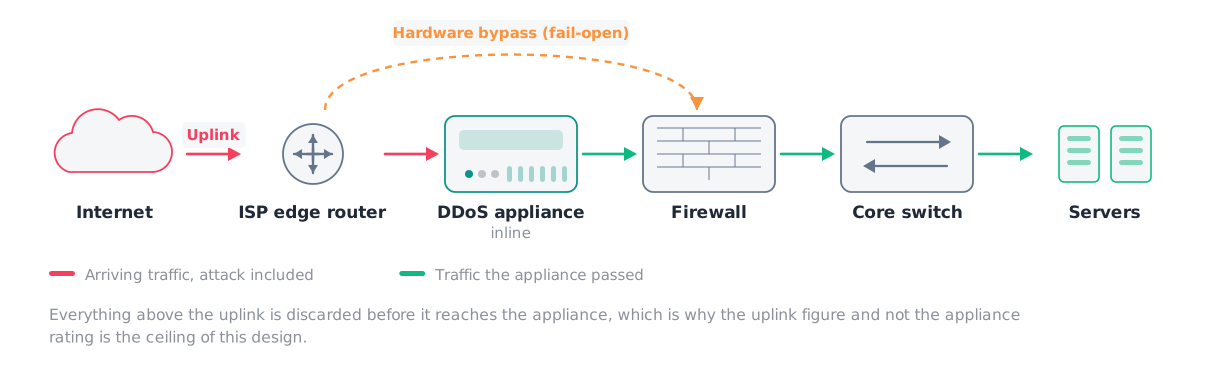
An attack against one tenant consumes shared resources: circuit capacity, the session tables of shared devices, the processing budget of anything inline, and the attention of the operations team. The tenant under attack may be a customer paying for a small virtual machine. The tenants degraded alongside them may be the platform’s largest accounts.
This is why damage does not scale with attack size. It scales with how many customers shared the path, which is an architectural choice made long before the attack.
The mitigations are structural rather than product decisions:
Segment the blast radius. Customers on separate address ranges, separate uplinks or separate edge devices share less. Complete separation is uneconomic; deliberate grouping is not.
Do not let one tenant reach shared ceilings alone. Any single tenant that can exhaust a shared session table has been given a capability nobody intended to sell.
Know where the shared choke points are. Usually a stateful device somewhere in the common path, and usually discovered during the incident rather than before it.
The null-routing problem
When one customer’s address is under an attack larger than the circuit, the fastest effective response is to discard everything destined for it — RTBH, applied at the provider’s edge or by the upstream.
It works. It protects every other tenant. And it completes the denial of service against the customer who was attacked, which is what the attacker set out to achieve.
The technique is not the issue. The issue is that this is a business decision being taken as an operational reflex, usually at 03:00, usually by someone with no authority to make it, and usually explained to the customer afterwards.
The fix is contractual and cheap: state in the service terms when null-routing may be applied, for how long, with what notice, and what compensation follows. A customer who has read that clause and signed is in a different position from one who discovers the policy during their own outage. It also converts an argument into an entitlement, which is faster for everyone.
More selective options exist and are worth having above the reflex: FlowSpec rules that discard only the attack’s characteristics, diversion of one tenant’s traffic to scrubbing, or filtering upstream on protocol and port. Each takes longer to apply than a null route, which is exactly why the ladder has to be written down before it is needed.
Per-tenant policy, and what isolation means
Multi-tenancy in this category is frequently sold as a reporting feature. For a hosting provider it is the mechanism that keeps different customers from breaking each other.
A tenant running a game server, a tenant running a corporate website and a tenant running an API have incompatible normal profiles. One policy across all three either refuses the game server’s ordinary traffic or is too permissive to protect the website. There is no single setting that serves them, which is why per-tenant policy is a platform requirement rather than a premium tier.
Four things need isolating, and products differ on how many they cover:
- Protection thresholds, set per tenant from that tenant’s measured traffic.
- Statistics visibility, so a customer sees their own traffic and nobody else’s.
- Alarms, routed to the right customer.
- Enforcement independence — one tenant’s volume must not trigger another tenant’s limits.
The fourth is the one to test rather than read about. A shared counter that a busy neighbour can push into a limit is isolation in the interface only, and it is a realistic failure.
You are also a source
A hosting estate is an attractive place to launch attacks from: the bandwidth is already paid for, the capacity is substantial, and a compromised or abusive tenant is hard to distinguish from a busy one.
The minimum is outbound rate monitoring per tenant, ingress filtering so that spoofed sources cannot leave your network, and a documented path from an abuse report to a suspension. All three also protect your own reputation, addressing and upstream relationships, which is usually the argument that gets them funded.
Making it a service rather than a cost
Most providers reach a point where a base level of protection is included for platform stability and additional protection is sold. That structure works, and the failure mode is offering no base at all — because an unprotected tenant’s incident still degrades paying customers.
The commercial mechanics, the tiering and the margin question are worked through in turning DDoS protection into a service, which applies to hosting providers and carriers alike. The buyer-side view of what such a platform must do is in the ISP buyer’s guide.
What to specify
- Per-tenant thresholds, statistics, alarms, and enforcement independence, the last one tested rather than described.
- Provisioning time for a new tenant policy.
- Per-tenant reporting produced without supplier involvement.
- The null-routing ladder: what is tried before it, and the contractual terms around it.
- Outbound monitoring and filtering per tenant.
- Capacity sized to the aggregate edge, with the shared choke points documented.
Frequently asked questions
- Is null-routing a legitimate response?
- It is legitimate, effective and drastic, and the problem is not the technique but the decision. Discarding traffic to the targeted address protects every other tenant and completes the denial of service against one. That trade should be written into the service terms — including how long, what notice, and what compensation — rather than made by an operator under pressure and explained afterwards.
- What does per-tenant policy actually need to isolate?
- Four things, and products vary on which they cover: the protection thresholds themselves, the statistics each tenant can see, the alarms each tenant receives, and the effect of one tenant's traffic on another's enforcement. The fourth is the one to test, because a shared counter that lets a busy tenant trigger a neighbour's limit is isolation on paper only.
- How do we handle attacks that originate inside our own estate?
- Assume they will. A hosting estate is an attractive place to run an attack from, because the bandwidth is already paid for. Outbound rate monitoring, outbound filtering per BCP 38, and a documented takedown path are the minimum, and they also protect you from being the subject of somebody else's abuse report.
- Should protection be included or sold separately?
- Both models work and mixing them badly does not. A base level for everyone keeps the platform stable regardless of what any tenant bought, which is a platform requirement rather than a product. Anything above that base can be a tier. What fails is offering no base at all and discovering that an unprotected tenant's attack degrades paying customers.
Sources
- RFC 5635 — Remote Triggered Black Hole Filtering with Unicast Reverse Path Forwarding
IETF · standard · accessed 2026-08-17
The mechanism behind null-routing a targeted customer, and the reason it is both effective and drastic.
- RFC 2827 / BCP 38 — Network Ingress Filtering
IETF · standard · accessed 2026-08-17
Outbound filtering obligations, which matter here because a hosting estate is also a potential source.
- RFC 8955 — Dissemination of Flow Specification Rules
IETF · standard · accessed 2026-08-17
Published: August 2026 · Last reviewed: August 2026
Reviewed means the sources above were re-read on that date; the text is only reissued when something material changed.
This guide is updated as vendors release new models and pricing. How we compare vendors