Attack class
DDoS as a Smokescreen: What the SOC Should Watch in Parallel
Last updated: August 2026 · Attention and log capacity are finite too · Reading time ~15 min
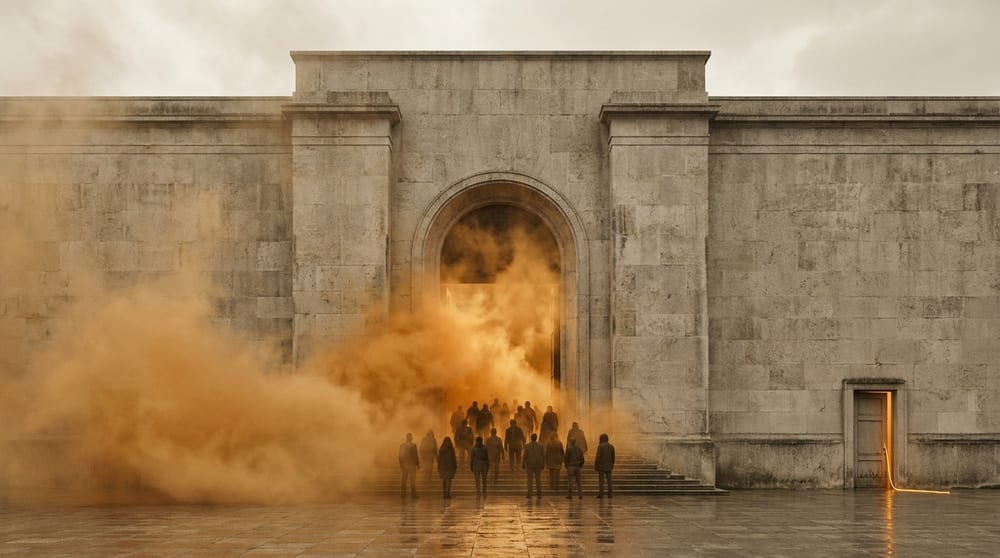
A denial-of-service attack degrades availability directly, and it can degrade detection as a side effect: analysts are consumed by the flood, and saturated firewalls, inspection engines and log pipelines drop events they would otherwise record. That makes a concurrent intrusion harder to see. The countermeasure is not suspicion — it is a second pair of eyes on a fixed list, and log integrity that survives the surge.
Denial of service is filed under availability, and that filing is correct. It is also incomplete, because of a property that has nothing to do with the attacker’s intent: a flood consumes finite resources beyond bandwidth, and two of them — analyst attention and the capacity of the controls behind the edge — are what detection is made of.
This page is about that mechanism. It is not about how often anyone exploits it deliberately, which is a question the public evidence cannot settle honestly.
At a glance
| Appliance | Finite resource | What the flood consumes | The blind spot it creates |
|---|---|---|---|
| Analyst attention | Every available responder, for the duration | Alerts outside the incident go unread, not unraised | |
| Stateful firewall capacity | Session table and CPU | Rules degrade or the device passes traffic to stay up | |
| Inspection engine throughput | Deep-packet inspection budget | Inspection is bypassed or sampled under load | |
| Log pipeline and SIEM ingest | Events per second against a licensed ceiling | Events are dropped, sampled or queued past usefulness | |
| Change control discipline | Time and patience | Emergency changes made without review and not reverted |
The last row is the one organisations do to themselves, and it is the one most often still in place a month later.
The first finite resource: attention
A serious flood puts every available responder on one problem. That is the correct response — the business impact is live and measured in revenue per minute.
The consequence is structural rather than a failure of discipline. Alerts continue to be raised; they stop being read. A privilege escalation at hour two of a four-hour incident enters a queue that nobody is working, and by the time the queue is drained the event is a day old and sits among hundreds of others generated by the incident itself.
Nothing here requires an attacker to have planned it. The blind spot exists whenever attention is concentrated, and it exists for the duration.
The second finite resource: the capacity of everything behind the edge
This is the mechanism that gets less attention and is easier to verify.
Stateful devices degrade before they fail. A firewall approaching its session-table ceiling begins to behave differently, and how it behaves is a design decision — some tighten, some pass traffic to remain available. That behaviour is worth knowing in advance rather than during. The economics of this pressure are worked through in the stateful paradox.
Inspection is expensive and gets shed first. Deep inspection costs far more per packet than forwarding. Under load, engines sample, bypass or drop inspection while continuing to forward — which is usually the right engineering choice and does mean the depth of inspection during the flood is not the depth advertised.
Log pipelines have a ceiling, and it is often licensed. This is the sharpest one. A flood multiplies events: every dropped packet, every blocked connection, every threshold crossing. Where a SIEM is licensed by events per second or ingest volume, the flood can push the estate past the ceiling — and what happens then is dropping, sampling, or queueing to the point of irrelevance. Security events unrelated to the flood compete for that same pipeline.
Whether your pipeline does this is measurable. Take the event rate your edge produces during a modest flood and compare it against the licensed rate. Most organisations have never done this arithmetic and are surprised by it.
Emergency changes. Under pressure, rules get relaxed, whole source ranges get permitted to restore a partner connection, inspection gets disabled to buy headroom. Each is defensible in the moment. The problem is that these changes are made without review and frequently survive the incident, so the estate is left in a weakened state that nobody is tracking.
The parallel list
The countermeasure is one person, a fixed list, and an instruction not to help with the flood. That constraint is the whole intervention: an analyst who joins the primary response will be absorbed by it within ten minutes.
Authentication. Successful logins from unusual sources or at unusual hours. Successes following failure bursts. Service and break-glass accounts used at all. Authentication from addresses inside the attack’s source ranges.
Privilege and identity. Group membership changes. New accounts. Permission grants. API keys, tokens or certificates issued. Password resets for privileged accounts.
Outbound traffic. This is the highest-value item, because inbound is where everyone is looking. Sustained outbound flows to unfamiliar destinations, volumes inconsistent with the service being down, and traffic that continues while inbound is throttled.
Configuration. Changes to firewall rules, routing, DNS records, cloud IAM policy, backup jobs and log forwarding. Any change to logging configuration during an incident deserves immediate attention regardless of who made it.
Endpoint. New persistence, new scheduled tasks or services, credential-access tooling, alerts suppressed or agents stopped.
The pipeline itself. Is ingest keeping up? Are sources that were reporting an hour ago still reporting? A source that goes quiet during an incident is either overwhelmed or has been silenced, and the two look identical on a dashboard.
Preserving what cannot be watched
Where only one responder exists, live parallel monitoring is not available and the fallback is evidence. Detection deferred is recoverable; evidence destroyed is not.
Three preparations, all made before an incident:
Protect the pipeline from the surge. Rate-limit or route high-volume mitigation telemetry separately so that it cannot crowd out authentication, endpoint and configuration events. Those three categories should have reserved capacity.
Keep local retention independent of the central system. A mitigation appliance holding its own incident record is holding evidence that survives a SIEM outage. This is one of the reasons local retention appears in the specification lists elsewhere on this site.
Record what you changed. An emergency change log written during the incident is worth more afterwards than any reconstruction. It also drives the revert list, which is where the post-incident review starts.
Fitting it into the response
The incident runbook covers the primary response. This adds three things to it and changes nothing else.
At the point the incident is declared, name a parallel monitor if headcount allows, and record the decision if it does not — including the reason, because that record is what justifies the resourcing request afterwards. Through the incident, log every emergency change as it is made rather than from memory. At stand-down, revert them, and treat the parallel list as an explicit section of the post-incident review even when it found nothing.
That last part matters. A parallel check that finds nothing is a result worth recording, and an organisation that never records the negative result cannot demonstrate the check was performed at all.
The honest summary
A flood degrades the controls that protect more than availability. That is a mechanism, it is verifiable in your own environment, and it costs one analyst’s attention to compensate for.
How often it is exploited deliberately is not established here, and a page claiming a figure would be inventing one. The mechanism is sufficient reason for the check, because the check is cheap and the alternative is discovering the answer from a regulator.
Frequently asked questions
- Is this a real pattern or security theatre?
- The mechanisms are real and testable in your own environment: you can measure whether your SIEM drops events at flood volumes, and you can check whether your inspection engines fail open under load. Whether attackers deliberately exploit this often is a separate question that this page does not answer, because the public evidence is a biased sample. The right posture is neither dismissal nor alarm — it is a cheap parallel check that costs one analyst's attention.
- Should the DDoS be ignored to look for the intrusion?
- No. Availability is the live business impact and it gets the primary response. The argument here is about *allocation*: reserve one person for the parallel list rather than putting everyone on the flood. If only one responder exists, the compensating control is evidence preservation, so that what could not be watched live can still be reconstructed afterwards.
- What single preparation matters most?
- Making sure the log pipeline survives the surge. Detection deferred is recoverable; evidence destroyed is not. If firewall and mitigation telemetry alone can exceed the SIEM's licensed ingest rate during a flood, then every other security event competing for that pipeline is at risk during exactly the window that matters most.
- Does this mean DDoS is a confidentiality control problem?
- It means a flood can degrade the controls that protect confidentiality and integrity, which is a different and more defensible statement than calling mitigation a confidentiality product. The defence remains an availability control. What changes is that its telemetry becomes relevant to investigations that are not about availability at all.
Sources
- SP 800-61 Rev. 3 — Incident Response Recommendations and Considerations for Cybersecurity Risk Management
NIST · standard · accessed 2026-08-16
Incident handling under concurrent events, and evidence preservation obligations during response.
- The NIST Cybersecurity Framework (CSF) 2.0
NIST · standard · accessed 2026-08-16
- RFC 4732 — Internet Denial-of-Service Considerations
IETF · 2006-11 · standard · accessed 2026-08-16
- Directive (EU) 2022/2555 (NIS2)
EUR-Lex · 2022-12-14 · regulator · accessed 2026-08-16
Reporting obligations that depend on evidence the surge must not have destroyed.
Published: August 2026 · Last reviewed: August 2026
Reviewed means the sources above were re-read on that date; the text is only reissued when something material changed.
This guide is updated as vendors release new models and pricing. How we compare vendors